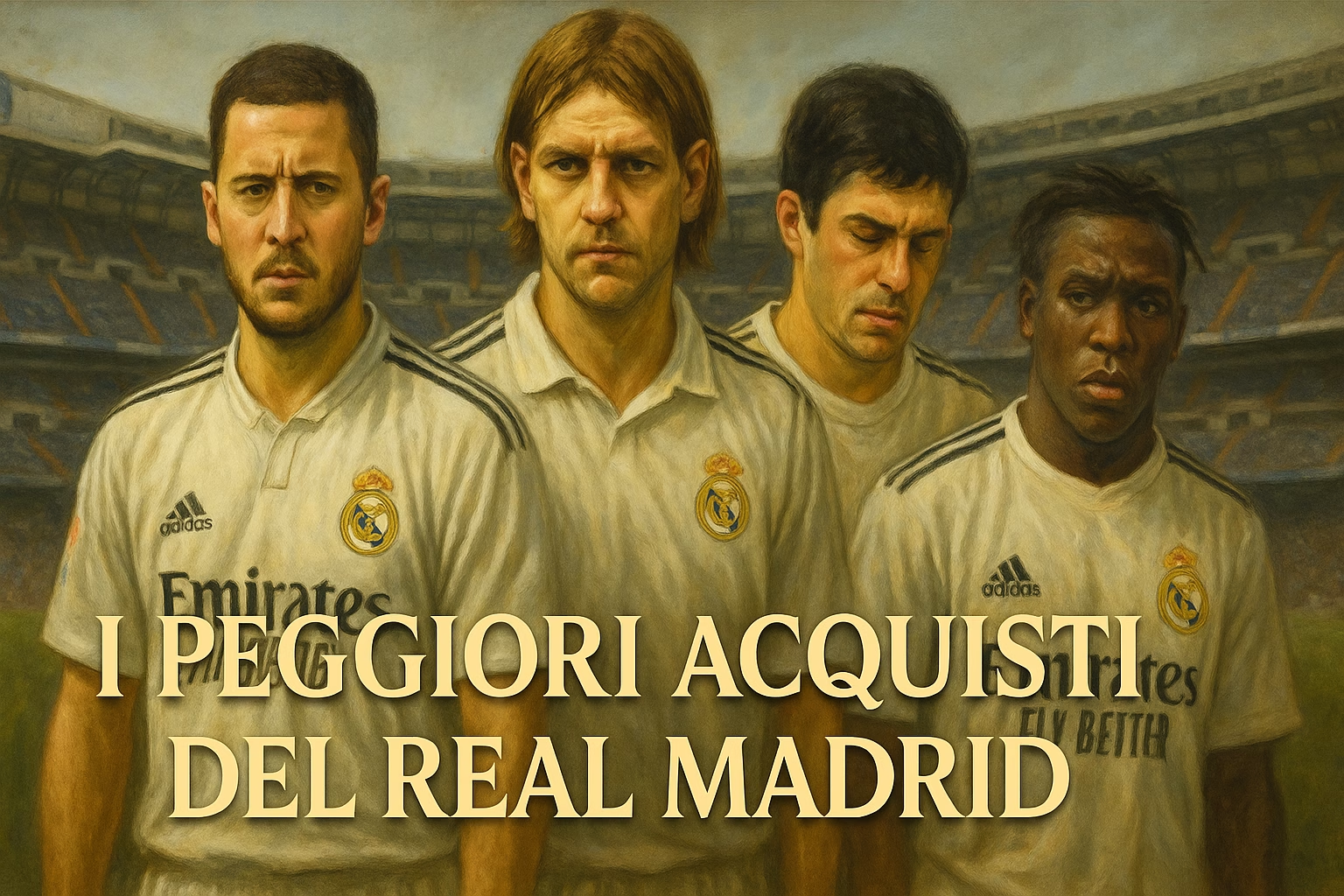
Evaluation criteria
By “worst purchase” we mean the discrepancy between price, expectations and actual performance. We evaluate availability (minutes), impact in key matches, statistical contribution (gol, assist, defensive interventions), tactical insertion and competitive context.
Sheets of emblematic cases
Eden Hazard (2019–2023)
Purchased as an absolute star, he lived four seasons affected by injuries. Budget: circa 7 gol in 76 official attendance. The termination of 2023 it closed a disappointing cycle compared to the initial investment.
Jonathan Woodgate (2004–2006)
He arrived already bruised; debuting in 2005 he scored an own goal and was sent off. The physical repercussions limited him to few appearances, becoming an emblematic case of underestimated medical risk.
Elvir Baljic (1999–2002)
True talent but held back by a torn ligament. With Real Madrid he scored only one official goal; the weight of the injury was decisive on the outcome of the operation.
Luka Jovic (2019–2021)
Exploit all'Eintracht, but in Madrid fatigue and competition reduce him: 2 gol in 30+ attendance. Case of complex adaptation to an elite context.
Royston Drenthe (2007–2010)
Physicality and speed are not enough without continuity. Limited impact despite beyond 60 overall attendance.
Thomas Gravesen (2005–2006)
Intense profile but not very compatible with Real's possession game. Left in the memory more for the character episodes than for the technical performance.
Nuri Sahin (2011–2013)
High quality, but injuries and competition limited its use before the loans.
Walter Samuel (2004–2005)
A complicated season in Madrid; much better performance in subsequent stages. Example of tactical and environmental mismatch.
Asier Illarramendi (2013–2015)
Director with perspective. Pressure and role in midfield reduced his influence until his return to Real Sociedad.
Julien Faubert (2009, loan)
Winter emergency operation without impact: very few minutes and goodbye at the end of the season.
Kaka (2009–2013) — relative flop
True champion, but unfavorable cost/return ratio due to expectations and injuries. Discreet numbers, overall perception below expectations.
Summary table
| Player | Period | Role | Attendance | Gol | Use |
|---|---|---|---|---|---|
| Eden Hazard | 2019–2023 | Striker | ≈76 | ≈7 | Injuries and continuity |
| Jonathan Woodgate | 2004–2006 | Defender | Few | 0 | Debut with own goal + red |
| Elvir Baljic | 1999–2002 | External | Limited | 1 | Ligament injury |
| Luka Jovic | 2019–2021 | Center forward | 30+ | 2 | Adaptation |
| Royston Drenthe | 2007–2010 | External | 60+ | 4 | Discontinuity |
| Thomas Gravesen | 2005–2006 | Midfielder | 40+ | 1 | Tactical fit |
| Nuri Sahin | 2011–2013 | Midfielder | Limited | 1 | Accidents |
| Walter Samuel | 2004–2005 | Defender | 30+ | 0 | A season |
| Asier Illarramendi | 2013–2015 | Midfielder | ≈90 | 3 | Pressure/role |
| Julien Faubert | 2009 | External | Very few | 0 | Loan |
| Kaka | 2009–2013 | Attacking midfielder | ≈120 | 29 | Relative flop |
Insights: RSSSF, Real Madrid (official site).
Why a purchase becomes a flop
1) Availability
Health affects minutes, match pace and continuity. Without constant availability, performance declines regardless of talent.
2) Tactical insertion
Different roles, tasks without the ball and speed of possession can enhance or nullify individual qualities.
3) Environmental adaptation
Lingua, habits, media pressure and internal competition require time and support. Not all profiles are suitable for the Bernabéu.
4) Economic expectations
The higher the expense, the more severe the public judgment. Even a decent return can appear disappointing compared to the opportunity cost.
FAQ — Frequently asked questions
- Who is the worst signing in the history of Real Madrid?
- For cost/performance ratio, many indicate Eden Hazard, affected by injuries and playing time reduced compared to expectations.
- There are flops that then exploded elsewhere?
- Yes. Walter Samuel he had a very high return afterwards. The tactical context makes the difference.
- A disappointing purchase is always the player's fault?
- No. Injuries often occur, choice of role, tactical ergonomics and pressure. Failure is multifactorial.
- Kaká must be called a total flop?
- No. It is correct to talk about a relative flop: acceptable numbers but lower than expected compared to the cost and fame at the time of purchase.
- What is the lesson for the modern market?
- Improve injury risk assessment, take care of tactical-cultural onboarding and calibrate the communication of expectations.
Updated to: 08/08/2025. The figures are based on official records/public archives; any deviations depend on the counting criteria.
Worst players in the history of Real Madrid
Historical analysis with data and context: not a list of “labels”, but a critical reading of the investment-return relationship.
Why a purchase becomes a flop
1) Availability
Health affects minutes, match pace and continuity. Without constant availability, performance declines regardless of talent.
2) Tactical insertion
Different roles, tasks without the ball and speed of possession can enhance or nullify individual qualities.
3) Environmental adaptation
Lingua, habits, media pressure and internal competition require time and support. Not all profiles are suitable for the Bernabéu.
4) Economic expectations
The higher the expense, the more severe the public judgment. Even a decent return can appear disappointing compared to the opportunity cost.
FAQ — Frequently asked questions
- Who is the worst signing in the history of Real Madrid?
- For cost/performance ratio, many indicate Eden Hazard, affected by injuries and playing time reduced compared to expectations.
- There are flops that then exploded elsewhere?
- Yes. Walter Samuel he had a very high return afterwards. The tactical context makes the difference.
- A disappointing purchase is always the player's fault?
- No. Injuries often occur, choice of role, tactical ergonomics and pressure. Failure is multifactorial.
- Kaká must be called a total flop?
- No. It is correct to talk about a relative flop: acceptable numbers but lower than expected compared to the cost and fame at the time of purchase.
- What is the lesson for the modern market?
- Improve injury risk assessment, take care of tactical-cultural onboarding and calibrate the communication of expectations.
Updated to: 08/08/2025. The figures are based on official records/public archives; any deviations depend on the counting criteria.