
Dernière mise à jour 25 Novembre, 2026 pour Alberto Llopís
How Editing Shapes Time in Football Documentaries
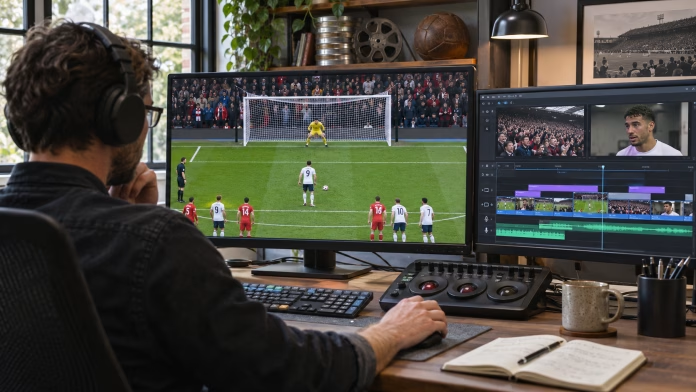
A second in a football documentary can feel much longer than a second on the match clock. A close-up of a player waiting to take a penalty, a shot of the stands and a few notes of music turn a short pause into a scene. The edit gives the footage meaning and changes how the audience experiences its duration.
1.Check whether two shots really belong together
An editor can put a shot of the coach next to a goal even when the reaction was filmed at a different point in the match. The cut makes it easy to read one image as an answer to the other. Look for the score, the clock, where the players are standing and whether the sound carries across the cut. A results page such as https://888starz.bet/fr can help you check the match result. For the timing of a particular reaction, read the footage itself.
When those cues are missing, keep your description modest. You can say the film cuts from the goal to the bench. To say this is how the coach reacted to that goal, you need evidence that connects the two shots.
2.Listen for the difference between memory and experience
A player speaking in an interview after the match already knows how it ended. In the match footage, the same player is deciding what to do without that knowledge. An interview can explain what the player remembers about a decision and what it came to mean later. A replay helps you see the options they faced at the time.
Watch what happens just before the interview is introduced. Hearing a player call a moment decisive can make a routine pass seem far more charged on the next viewing. That shift tells you something about the film’s arrangement of footage and testimony.
3.Keep track of jumps in time
A documentary can move from a match to a recent interview, then back to a training session. Look for dates, changes in kit, a different training ground or a transition the narrator explains. These details are useful when the order of events matters to the story.
You can follow a film without reconstructing every day. If you are discussing a specific decision, though, it helps to know whether someone made a remark before the match or long after it. One tells you how they understood the situation at the time. The other shows how they remember it now.
4.Notice what stays off camera
The camera follows only part of what is happening. A conversation may have been unrecorded, left out during editing or simply outside the scope of the film. An interview that gets a great deal of screen time may be important to the story even if it covers a small part of the team’s season.
Ask what the filmmaker has chosen to make visible. Is the film tracing one player’s work, the habits of a squad, a disagreement or how a competition is remembered? That question helps you judge the film on what it sets out to show.
5.Compare the edit with a continuous recording
If a longer recording is available, compare a short stretch of it with the equivalent scene in the documentary. Note where each version starts and stops. You might find that the film drops an interruption to keep the story moving or extends a pause by cutting between the players and the crowd.
Then ask whether the cut changes the pace or suggests a cause. Removing a few seconds after a foul may keep a scene moving. Cutting directly from a coach’s gesture to a tactical switch may suggest the gesture brought about the change. A brief comparison helps you say which effect you are responding to.
6.Give yourself time to think after the film
Jot down what you saw, what the people in the film say happened and what you infer from it. Return to a passage if the distinction matters. If the film mentions a match result, an app such as https://apps.apple.com/cm/app/888starz-pari-sportifs/id6475004245 can help you check the score. Keep track of where each detail came from.
You can use the same method in a conversation after the screening. Pick a scene and ask each person which images stayed with them and what they made of those images. A change in sound or a cut to the stands may explain why two people remember the scene differently. The discussion can then focus on how the film produces those readings.
A documentary can move you and reward a second look. Pay attention to who gets the most screen time, what the film leaves off camera and when the music starts. Those choices give an unpredictable match a beginning, moments of anticipation and an ending the viewer can return to.
Abonnez-vous pour obtenir les derniers articles envoyés à votre e-mail.

