
Last update 10 June, 2026 by football hung
The World Cup format 2026 marks a huge change in World Cup history. For the first time, the tournament is played with 48 selections, 3 host countries and a longer calendar that will force us to look at the championship in a different way. It's no longer the World Cup 32 teams we met from France 1998: now there are more places, more matches, more small stories and a new path to the champion.
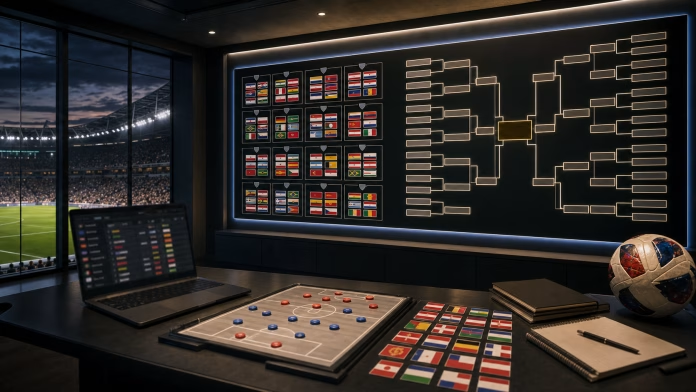
The key to understanding the World Cup 2026 it's simple: there will be 12 groups of 4 selections, a larger group stage and a round of 32 that opens the knockout draw before the round of 16. In Colgados you can now also consult the World Cup squad lists 2026, a guide that fits perfectly with this review of the competition system.
| Given | World 2026 |
| Selections | 48 |
| Groups | 12 groups of 4 |
| They qualify for the playoffs | Los 2 first in each group and the 8 best third parties |
| First qualifying round | Round of 32 |
| Scheduled matches | 104 |
What changes regarding the format of 32 selections
The most visible change is the number of participants. Pass from 32 a 48 selections means opening the tournament to more federations, especially from confederations that historically had fewer places. This increases competitive diversity and allows emerging teams a real opportunity to enter the World Cup map..
The group stage also changes scale. Instead of 8 groups, the world 2026 is organized in 12 groups. Each selection maintains 3 Guaranteed matches in the first phase, something important because it avoids the format of groups of 3 that was raised for a while and that could generate too many calculations on the last day.
How the teams are classified in the round of 32
The system rewards 2 first in each group, who go directly to the playoffs. Added to them are the 8 best third parties. In total, 32 teams are still alive after the group stage. That round of 32 It is one of the great novelties of the tournament and will make the first phase have more margin for survival, but also more accounts for third parties.
The classification of the best third parties will depend on points, goal difference, goals in favor and tiebreaker criteria. This will mean that seemingly secondary matches can have a lot of impact on the final draw.. A goal scored in stoppage time in a group can change the rival of another team located thousands of kilometers away.
Why the new format can change the strategy
Con 48 equipment, selectors will have to better manage attrition. The champion must travel a longer path with more crossing possibilities. The group stage will continue to be decisive, but the presence of sixteenths increases the weight of the rotations, accumulated minutes and squad depth.
It can also change the emotional reading of the tournament. Before, many medium-sized teams knew that a bad debut would almost leave them out. In 2026, third place can have value, so an initial defeat does not necessarily sink the project. This can give more open matches on the second and third days..
What it means for favorites
For the big selections, the new format can be an advantage and a risk at the same time. In theory, there is more room to correct a setback in the group stage. In practice, There is also an additional eliminatory in which any mistake sends you home. France, Argentina, Brazil, Spain, England or Portugal will not only need quality; They will need to control rhythms and avoid injuries.
That's why the World Cup 2026 may seem longer before you even start. The champion will not only be the best team in a final, but the one who best manages a tour of 104 global matches and several venues spread across Canada, Mexico and the United States.
The historical impact of the World Cup 48 selections
The jump of 32 a 48 teams will be comparable to other major format changes in the history of the World Cups. The tournament has already changed with the appearance of group stages, modern playoffs, penalty shoot-outs or expansion of participants. In that context, 2026 It will be a reference edition to measure if the World Cup wins more stories without losing intensity.
The underlying question is whether more games mean a better tournament.. The answer will depend on the competitive quality, of the excitement of the crossings and whether the new teams take advantage of their window. when we remember the best World Cups in history, we don't always talk about the favorite: many times we talk about surprises, debutants and matches that no one expected.
What fans should watch during the group stage
The fan must get used to reading the classification with more layers. It will not be enough to look at who is first or second.. In many groups, Third place can be a live zone until the last minute. This will make the simultaneous scores have a lot of weight and the goal difference will be an obsession for selectors and analysts..
It will also be important to look at the rest schedule. In a World Cup spread across 3 countries, not all routes will be equally comfortable. A team that wins its group soon will be able to reserve players and prepare better for the matches.. Another one that reaches the third day with emergencies will have to spend headlines, take risks and perhaps travel with less margin of recovery.
Frequent questions
How many teams are playing in the World Cup? 2026?
The world Cup 2026 is played with 48 selections, the highest number in men's World Cup history.
How many groups are there in the World Cup? 2026?
There are 12 groups of 4 selections. Each team disputes 3 matches in the first phase.
Who goes to the playoffs?
Pass the 2 first in each group and the 8 best third parties, forming a round of 32 equipment.
Sources consulted
Official source: FIFA, World Cup 2026. Official calendar: FIFA, World Cup match schedule 2026.
Subscribe to get the latest posts sent to your email.

