
Last update 17 June, 2026 by Alberto Llopis
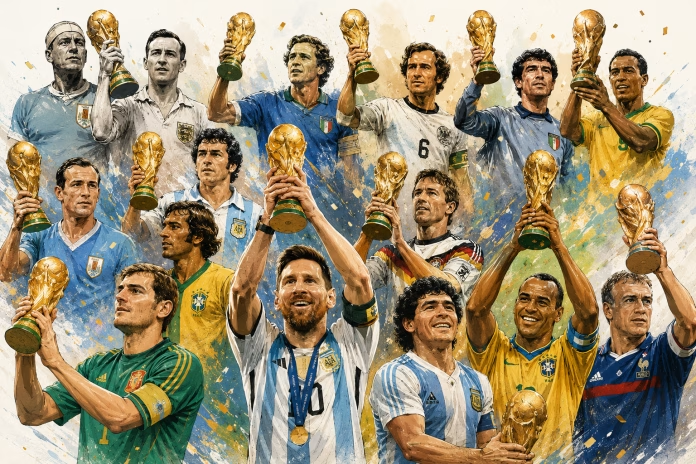
Raise the World Cup It is the most powerful gesture in football. The captain goes up to the box, receive the trophy, raises it to heaven and turns a generation into legend. Behind that image there are names that are part of the collective memory of sport: José Nasazzi, Obdulio Varela, Bobby Moore, Charles Albert, Franz Beckenbauer, Dino Zoff, Diego Maradona, Dunga, Didier Deschamps, Coffee, Fabio Cannavaro, Iker Casillas, Philipp Lahm, Hugo Lloris or Lionel Messi.
Since the first World Cup 1930 to Qatar 2022, there has been 22 men's editions of the World Cup y, therefore, 22 world champion captains. The tournament is held from 1930 and was only interrupted by World War II, when the editions of 1942 y 1946. The next captain to lift the Cup will emerge from the World Cup final 2026, scheduled for 19 July at New York New Jersey Stadium, commonly known as MetLife Stadium.
All world champion captains
This is the complete list of captains who lifted the World Cup, from Uruguay 1930 to Argentina 2022.
| Year | champion team | champion captain | Coach | Final |
|---|---|---|---|---|
| 1930 | Uruguay | José Nasazzi | Alberto Suppici | Uruguay 4-2 Argentina |
| 1934 | Italia | Gianpiero Combi | Vittorio Pozzo | Italia 2-1 Czechoslovakia |
| 1938 | Italia | Giuseppe Meazza | Vittorio Pozzo | Italia 4-2 Hungary |
| 1950 | Uruguay | Obdulio Varela | Juan Lopez Fontana | Uruguay 2-1 Brazil |
| 1954 | Federal Germany | Fritz Walter | Sepp Herberger | Federal Germany 3-2 Hungary |
| 1958 | Brazil | Hilderaldo Bellini | Vicente Feola | Brazil 5-2 Sweden |
| 1962 | Brazil | Mauro Ramos | Aymore Moreira | Brazil 3-1 Czechoslovakia |
| 1966 | England | Bobby Moore | Alf Ramsey | England 4-2 Federal Germany |
| 1970 | Brazil | Carlos Alberto Torres | Mario Zagallo | Brazil 4-1 Italia |
| 1974 | Federal Germany | Franz Beckenbauer | Helmut Schön | Federal Germany 2-1 Netherlands |
| 1978 | Argentina | Daniel Passarella | César Luis Menotti | Argentina 3-1 Netherlands |
| 1982 | Italia | Dino Zoff | Enzo Bearzot | Italia 3-1 Federal Germany |
| 1986 | Argentina | Diego Maradona | Carlos Bilardo | Argentina 3-2 Federal Germany |
| 1990 | Federal Germany | Lothar Matthäus | Franz Beckenbauer | Federal Germany 1-0 Argentina |
| 1994 | Brazil | Dunga | Carlos Alberto Parreira | Brazil 0-0 Italia, 3-2 penalty shootout |
| 1998 | France | Didier Deschamps | Aimé Jacquet | France 3-0 Brazil |
| 2002 | Brazil | Coffee | Luiz Felipe Scolari | Brazil 2-0 Germany |
| 2006 | Italia | Fabio Cannavaro | Marcello Lippi | Italia 1-1 France, 5-3 penalty shootout |
| 2010 | Spain | Iker Casillas | Vicente del Bosque | Spain 1-0 Netherlands |
| 2014 | Germany | Philipp Lahm | Joachim Löw | Germany 1-0 Argentina |
| 2018 | France | Hugo Lloris | Didier Deschamps | France 4-2 Croatia |
| 2022 | Argentina | Lionel Messi | Lionel Scaloni | Argentina 3-3 France, 4-2 penalty shootout |
The historical list of champions, captains and coaches matches World Cup history reference lists and World Cup final records.
Champion captains by national team
Brazil is the team that has seen one of its captains lift the Cup the most times. Then Germany and Italy appear, both with four champion captains.
| Selection | Champion captains | Years |
|---|---|---|
| Brazil | 5 | 1958, 1962, 1970, 1994, 2002 |
| Germany / Federal Germany | 4 | 1954, 1974, 1990, 2014 |
| Italia | 4 | 1934, 1938, 1982, 2006 |
| Argentina | 3 | 1978, 1986, 2022 |
| Uruguay | 2 | 1930, 1950 |
| France | 2 | 1998, 2018 |
| England | 1 | 1966 |
| Spain | 1 | 2010 |
The data also reflects the historical record of the World Cup: only eight teams have been world champions until 2022. Brazil leads with five titles, followed by Germany and Italy with four, Argentina with three, Uruguay and France with two, and England and Spain with one.
José Nasazzi, the first world champion captain
The first captain to lift the World Cup was José Nasazzi, defense and leader of Uruguay in 1930. La Celeste won the first World Cup in history after beating Argentina by 4-2 in Montevideo.
Nasazzi was not only the captain of the first world champion. It also symbolized a golden era of Uruguayan football, who had just won the Olympic gold medals 1924 y 1928. His name opens the list of great World Cup leaders.
In a history full of offensive stars, the first champion captain was a defender. This trend would be repeated many times: The World Cup usually ends up in the hands of players who order, They command and support the team from behind.
Obdulio Varela, the captain of the Maracanazo
If there is a captain who represents competitive leadership in its purest form, that is Obdulio Varela. The Uruguayan was the head of the team that won the World Cup 1950 against Brazil at the Maracaná.
That tournament had a peculiarity: It was not decided with a classic final, but with a final league. The last match, Brazil-Uruguay, ended up functioning as a de facto final. A draw was enough for Brazil, but Uruguay won 2-1 and caused the famous Maracanazo.
Varela was much more than a captain with an armband. He was the emotional leader of a team that played against the favorite, against the stadium and against the coronation atmosphere that was already in the air in Brazil. That is why his figure continues to be one of the most respected in the history of the World Cups..
Bobby Moore, England's eternal captain
Bobby Moore rose in 1966 England's only World Cup. He did it at Wembley, after an unforgettable final against West Germany that ended 4-2 after extension.
Moore was an elegant central defender, cleansed, with game reading and natural authority. His image receiving the trophy from Queen Elizabeth II is one of the most iconic photographs of English football..
England has had great generations since then, but no other English captain has touched the World Cup again. Moore continues to be the ultimate symbol of English football at national team level. One of the best English players ever.
Charles Albert, the captain of Brazil 1970
Carlos Alberto Torres was the captain of the Brazil's 1970, Considered by many as one of the best teams of all time. That team had Pelé, Jairzinho, penny, Rivelino and Gérson, but the one who lifted the Cup was Carlos Alberto.
His World Cup was immortalized by more than just the bracelet: He scored Brazil's fourth goal in the final against Italy, culminating one of the most famous collective plays in the history of football. FIFA remembers Carlos Alberto as captain of that Brazilian team and highlights that goal as one of the great offensive movements of the game.
Brazil won 4-1 to Italy in the Aztec Stadium and won his third World Cup. With it, remained the owner of the Jules Rimet Cup.
Franz Beckenbauer, the captain who also won as a coach
Franz Beckenbauer he lifted the World Cup as captain of West Germany in 1974. They defeated Johan Cruyff's Netherlands in the final, the famous “Clockwork Orange”, and consolidated his legend as one of the great leaders in history.
Beckenbauer was not just any defender. He revolutionized the figure of the libero, He commanded from behind and turned the ball out into a form of authority. Years later he won the World Cup again, this time as a coach, in Italy 1990. Associated Press collects this double historical condition: champion captain in 1974 and champion coach in 1990.
Only a few names have managed to win the World Cup as players and coaches. Among the champion captains, Beckenbauer and Didier Deschamps are the two great examples.
Daniel Passarella, Argentina's first champion captain
Before Maradona and Messi, Argentina had Daniel Passarella. The center back was the captain of the champion team in 1978, in the World Cup played at home.
Passarella lifted the Cup after the victory by 3-1 against the Netherlands at the Monumental in Buenos Aires. He was a defender of character, personality and goal. He was also part of the Argentine team that won the World Cup. 1986, although he did not have a leading role on the field during that tournament.
Your case is special: He was champion captain in 1978 and member of Argentina champion in 1986. No Argentinian has won more World Cups than him..
Dino Zoff, the oldest captain to win a World Cup
Dino Zoff It is one of the most impressive cases in history. The Italian goalkeeper lifted the World Cup in 1982 con 40 years, becoming the oldest world champion in history. FIFA maintains Zoff as the oldest man to have won a World Cup.
Italy won that final by 3-1 to West Germany at the Santiago Bernabéu. Zoff was serenity, command and security. In a tournament marked by Paolo Rossi, the goalkeeper and captain was the figure that emotionally supported the team.
It also left a precious rarity: He was European champion in 1968 and world champion in 1982, con 14 years of difference between both titles.
Diego Maradona, the total captain of Mexico 1986
Diego Armando Maradona not only did he lift the World Cup in 1986. He conquered it with one of the most dominant individual performances in the history of football.
Maradona was the absolute leader of Argentina in Mexico. FIFA remembers that he won the Ballon d'Or of the tournament, He scored five goals and generated another five, participating directly in 10 of the 14 argentine goals.
His World Cup includes the “Hand of God”, the “Goal of the Century” against England, the decisive assist to Jorge Burruchaga in the final and the eternal image of the captain lifting the Cup at the Azteca Stadium. Few captains have had such a direct relationship between leadership, game and title.
Lothar Matthäus, German revenge 1990
Lothar Matthäus raised the World Cup in Italy 1990. West Germany defeated 1-0 to Argentina with a penalty from Andreas Brehme and took revenge for the final lost four years earlier in Mexico.
Matthäus was a total midfielder: physicist, arrival, shooting, character and tactical reading. He captained a solid Germany, competitive and mature, directed by Franz Beckenbauer.
That victory was also the last World Cup won by West Germany before German reunification..
Dunga, the captain who changed the story of Brazil
The Brazil of 1994 It wasn't the most romantic nor the most offensive., but he was champion. And their captain was Dunga, a tough midfielder, tactical and competitive.
After Brazil's failure in 1990, Dunga was used as a symbol of a less showy style. Four years later, lifted the Cup in the United States after beating Italy in the penalty shootout.
Dunga represents an important idea: not all champion captains are the most technically brilliant. Some are the ones that give balance, discipline and structure to teams full of talent.
Didier Deschamps, captain in 1998 and selector in 2018
Didier Deschamps He was the captain of France, world champion in 1998. That team defeated 3-0 to Brazil in Saint-Denis and won the first World Cup in its history.
Deschamps was the balance of a team full of talent. He was not the most spectacular footballer, but one of the most important for France to function. years later, He repeated the feat as coach in Russia 2018, becoming one of the great names in the history of French football. Reuters defines him as a figure who won the highest title both as a player and as a coach..
His case places him on a privileged list along with Franz Beckenbauer and Mário Zagallo, although Zagallo was not a champion captain as a player.
Coffee, the captain of the fifth World Cup in Brazil
Coffee rose in 2002 the fifth World Cup in Brazil. He was the captain of a team with Ronaldo, Rivaldo, Ronaldinho, Roberto Carlos and company.
Brazil won the final 2-0 to Germany in Yokohama, with Ronaldo Nazário's goals. Coffee, tireless right back, became a historical image for its celebration with the Cup.
Besides, has brutal information: Cafú is the only footballer to have played in three World Cup finals, in 1994, 1998 y 2002. He won two of those World Cups, although he only lifted the Cup as captain in 2002.
Fabio Cannavaro, the defender who won the Ballon d'Or
Fabio Cannavaro He was the captain of Italy in the World Cup 2006. That team won the final against France on penalties after the 1-1 in Berlin.
Cannavaro had an extraordinary tournament. As a central, He was the leader of a very solid Italy defensively and ended the year winning the Ballon d'Or. His image lifting the Cup represents one of the great historical demands of the defenders.
Italy has not won a World Cup since then. In fact, Their subsequent absences in several final phases have further increased the value of that group.
Iker Casillas, the captain of champion Spain
Iker Casillas rose in 2010 Spain's first World Cup. La Roja won 1-0 to the Netherlands with Andrés Iniesta's goal in extra time.
Casillas was captain, goalkeeper and symbol of an unrepeatable generation. He came from winning the Euro Cup 2008 and then it would complete the cycle with the Euro Cup 2012. In South Africa he left one of the most important stops in the history of Spain: heads-up against Arjen Robben in the final.
For Spanish football, His image lifting the Cup in Johannesburg is probably the most important photograph in the history of the national team..
Philipp Lahm, the captain of Germany 2014
Philipp Lahm He was the captain of Germany in Brazil 2014. He lifted the Cup in Maracaná after the victory by 1-0 against Argentina, decided by Mario Götze's goal in extra time.
Lahm was a footballer of surgical precision: lateral, midfielder, tactical leader and player of maximum reliability. FIFA remembers that in 2014 He became the first German captain in 24 years to lift the World Cup.
His leadership was less noisy than that of other captains, but extremely effective. Germany won that World Cup with a mix of talent, structure, automatisms and collective authority.
Hugo Lloris, the second champion captain of France
Hugo Lloris He was the captain of France in Russia 2018. The French won 4-2 Croatia in the final and won their second World Cup.
Lloris was the second French captain to lift the Cup, after Didier Deschamps in 1998. His case is also particular because he returned to play in a World Cup final as captain in 2022, although that time France fell to Argentina on penalties.
Sober goalkeeper, Very international and respected within the locker room, Lloris represents the silent leadership of a team full of offensive talent.
Lionel Messi, the last world champion captain
Lionel Messi closed in Qatar 2022 one of the most anticipated stories in football. Argentina won the World Cup after tying 3-3 with France and win 4-2 on penalties.
Messi was captain, scorer, assistant and emotional leader of the Albiceleste. Besides, Guinness World Records states that Messi reached the record for 19 matches as captain in World Cups in between 2010 y 2022, including all seven Qatar matches, where he lifted the Cup.
His image with the trophy completed a career that already had Champions, Golden Balls, Copa América and almost every record imaginable. But the World Cup was missing. And raised her as captain.
Facts and curiosities about the world champion captains
World champion captains do not follow a single pattern, but they do leave several interesting facts.
| Given | Hero |
|---|---|
| First champion captain | José Nasazzi, Uruguay 1930 |
| Last champion captain | Lionel Messi, Argentina 2022 |
| Oldest captain to win the World Cup | Dino Zoff, Italia 1982, con 40 years |
| Youngest captain to lift the Cup | Daniel Passarella, Argentina 1978 |
| First champion captain goalkeeper | Gianpiero Combi, Italia 1934 |
| First South American champion captain | José Nasazzi |
| First European champion captain | Gianpiero Combi |
| Only Spanish captain world champion | Iker Casillas |
| Captain with the most World Cup matches with armband | Lionel Messi |
| Captains who later won as coaches | Franz Beckenbauer and Didier Deschamps |
What position did the champion captains have??
An interesting read is that many champion captains have been defenders, balance goalkeepers or midfielders. That is to say, players with a global vision of the team, not always the big offensive stars.
| Dominant position | Featured captains |
|---|---|
| Defenses and sides | Nasazzi, Bellini, Mauro Ramos, Bobby Moore, Charles Albert, Beckenbauer, Passarella, Coffee, Cannavaro, lame |
| Goalkeepers | Combi, Zoff, Casillas, Lories |
| Midfielders | Obdulio Varela, Matthew, Dunga, Deschamps |
| attackers / midfields | Meazza, Fritz Walter, Maradona, Messi |
The conclusion is clear: the leadership of a world champion is usually at the axis of the team. In own area, in defense, in the core or in the figure that marks the emotional identity of the group.
Captains who made history beyond lifting the Cup
Not all champion captains are remembered in the same way. Some were linked to a play, others to a generation and others to a national symbol.
Obdulio Varela represents psychological leadership. The Maracanazo is not understood without its authority on the field.
Charles Albert represents football beauty. His goal in the final of 1970 It is a collective work that continues to appear in any review of the best goals of the World Cups.
Franz Beckenbauer represents elegance and tactical command. He was champion as captain and later as coach.
Diego Maradona represents a player's total influence over a tournament. Mexico 1986 bears his name.
Dino Zoff represents competitive longevity. Win a World Cup with 40 years and as captain it is a mark almost impossible to match.
Iker Casillas represents the highest moment of Spanish football. His stop to Robben and his lifting of the Cup are pure history of the national team.
Lionel Messi represents the culmination of a career. Qatar 2022 He closed the only chapter that was missing from his legend.
No player has lifted two World Cups as captain
One of the most striking data is that No footballer has won two World Cups as captain. Some won more than one World Cup as players, but they did not repeat the gesture of raising the Cup with the bracelet.
For example, Giuseppe Meazza won the World Cups 1934 y 1938, but he was captain in 1938. Bellini He was champion with Brazil in 1958 y 1962, although he lifted the Cup in 1958. Mauro Ramos won both tournaments, but he was captain in 1962. Coffee won in 1994 y 2002, but he only lifted the trophy as captain in 2002. Daniel Passarella was champion in 1978 y 1986, although his great moment as captain was the World Cup in Argentina 1978. IFFHS includes several of these players with more than one world title and highlights the case of Cafú as the only player present in three World Cup finals..
This data further increases the value of the moment. Lifting a World Cup as captain is something that, until now, no one has repeated it twice.
The champion captains who were also champion coaches
There are two names that stand out above the rest: Franz Beckenbauer y Didier Deschamps.
Beckenbauer was champion captain with West Germany in 1974 and champion coach in 1990. Deschamps was champion captain with France in 1998 and champion coach in 2018. They are two perfect examples of leadership transferred from the field to the bench..
There is also the case of Mario Zagallo, champion as a player with Brazil in 1958 y 1962, and champion as a coach in 1970. But Zagallo was not a champion captain, That's why it doesn't fall into this specific category..
Frequently asked questions about world champion captains
Who was the first world champion captain?
The first world champion captain was José Nasazzi, from Uruguay, in the World Cup 1930. Uruguay won 4-2 to Argentina in the final played in Montevideo.
Who was the last world champion captain?
The last world champion captain is Lionel Messi, who lifted the Cup with Argentina in Qatar 2022 after beating France on penalties.
Which captain lifted the World Cup with Spain?
The only Spanish captain who has lifted the World Cup is Iker Casillas, in South Africa 2010.
Which captain won the World Cup at the oldest age??
The oldest captain to win a World Cup was Dino Zoff, Italy goalkeeper, champion in 1982 con 40 years.
Which captains won the World Cup as players and coaches?
The big cases are Franz Beckenbauer y Didier Deschamps. Beckenbauer was champion as captain in 1974 and coaching 1990. Deschamps was champion as captain in 1998 and as a coach in 2018.
Have there been world champion goalkeeper captains?
Yes. Among the goalkeepers who lifted the Cup as captains are Gianpiero Combi, Dino Zoff, Iker Casillas y Hugo Lloris.
Who was Brazil's captain in the World Cup? 2002?
Brazil's captain in the World Cup 2002 was Coffee. Brazil won the final 2-0 to Germany and won his fifth world title.
Who was the captain of Argentina in 1986?
The captain of Argentina in Mexico 1986 was Diego Armando Maradona, great figure of the tournament and leader of the champion team.
Who was the captain of France in 1998?
The captain of France in 1998 was Didier Deschamps. France won its first World Cup after defeating 3-0 to Brazil in the final.
Who will be the next world champion captain??
The next world champion captain will be known in the World Cup final 2026, scheduled for 19 July in the New York/New Jersey area.
The heaviest bracelet in football
Being a world champion captain is much more than wearing an armband. It's being the face of a generation, the first to touch the Cup and the player who remains forever in the official photograph of glory.
Some were defensive leaders, as Nasazzi, Moore, Beckenbauer, Passarella or Cannavaro. Others were historic goalkeepers, as Zoff, Casillas or Lloris. There were also character midfielders, as Dunga, Matthew o Deschamps. And there were absolute geniuses, as Maradona and Messi, capable of dragging an entire country to the top.
The list of world champion captains is, In fact, a different way of telling the story of the World Cups. Each name sums up an era, a style and a selection. Everyone won in different ways, but they all share the same eternal moment: lift the World Cup.
Subscribe to get the latest posts sent to your email.

