
Last update 12 August, 2026 by Alberto Llopis
The European Cup Winners' Cup It disappeared because European football changed its logic. Said like that it sounds clean, almost administrative. But behind that phrase there is a huge loss: A competition that did not reward the regularity of the League left, but the coup of the Cup, the inspired night, the survivor tournament. A cup that allowed a medium-sized club to, even one without a giant structure, have a real European adventure.

The European Cup Winners' Cup was born to bring together the national Cup champions. It wasn't the European Cup, reserved for the league champions, It wasn't the Fairs Cup or UEFA, where other classifieds entered. It was something else: a competition with the aroma of cupbearing Sunday, with teams arriving from Wembley, the Bernabeu, Hampden Park, the Olympic Stadium in Rome or any stadium where a national final could change a season. In Colgados we have already talked about lthe missing European cups, but the Cup Winners' Cup deserves its own look because its disappearance says a lot about modern football.
The European Cup Winners' Cup: The cup champions tournament
Between 1960 y 1999, The Cup Winners' Cup built a very rare and precious record. Huge clubs like Barcelona won it, Milan, Juventus, Bayern, Chelsea, Manchester United o Lazio, but also teams that found their brightest page there: Aberdeen, Magdeburg, Dynamo Tbilisi, Mechelen, Zaragoza, Valencia o Slovan Bratislava. That mix was the charm. In the same competition, Cup champions from powerful leagues and Cup champions from countries that did not always appear in the continental elite coexisted..
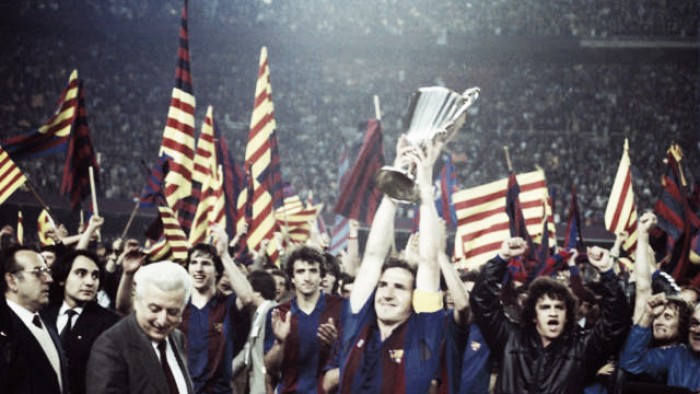
The fact that best defines the tournament is almost poetic: no club managed to win it two years in a row. Barcelona was the most successful, con 4 titles, but even he couldn't hold it. According to the historical record of RSSSF, the Cup Winners' Cup produced 39 editions and a very open champion map by European standards. The cup was not perfect, but it was unpredictable. And unpredictability is one of the first victims when football is organized only around money and television.. Their last champion was Lazio in a final against RCD Mallorca.
Why did it stop having a place?
The short answer is that the Champions League grew and the UEFA Cup absorbed space. From the years 90, The European Cup stopped being just a champions' cup and began to open up to more teams from the major leagues. At the same time, UEFA needed to simplify the continental calendar and promote a second, broader tournament. In that scenario, maintaining an exclusive competition for Cup champions seemed less profitable and less comfortable.
The last Cup Winners' Cup was played in 1999. Lazio won 2-1 to Mallorca in Villa Park and, as one's own remembers UEFA in its review of the Super Cup 1999, The Italian club was the last Cup Winners' Cup champion before playing the Super Cup against Manchester United. That ending closed a story that had been going on since 1961 and that he had left scenes impossible to put in a spreadsheet.
What European football lost
Lost an alternative avenue of prestige. Winning the national Cup had a huge prize: Europa. Not a decorative preview round, but a tournament with a name, emotional anthem and own ending. That made the domestic Cups have a special burden. For a club that couldn't win the League, lift the King's Cup, The FA Cup or the Coppa Italia opened a perfectly recognizable European door.
He also lost a competition that was easier to explain. Cup champions against Cup champions. Point. Modern football has improved many things, but sometimes it has become an expert in manufacturing formats that require an instruction manual. The Cup Winners' Cup had an obvious competitive defect, because not all Cup champions had the same level, but he also had a virtue that is worth gold today: anyone understood what was being played.
The Spanish footprint
Spain was a power in the Cup Winners' Cup. Barcelona won 4 times and played 6 finales. Atlético de Madrid conquered the 1962 before Fiorentina. Valencia won in 1980 to Arsenal on penalties. Real Zaragoza raised the 1995 with Nayim's eternal goal against Arsenal, a story we tell in detail in Nayim's goal made Zaragoza champion of the Cup Winners' Cup. And Mallorca was the last Spanish finalist in 1999.
That footprint is not coincidental. The Copa del Rey always had a strong emotional weight in Spain, and the Cup Winners' Cup amplified that weight. Winning the Cup was not just about lifting a national title; was to earn a passport to Europe. That is why many Spanish clubs that have not dominated leagues do have very powerful European chapters.. In that sense, The Cup Winners' Cup helps to better understand the historical relationship between Spanish football and continental competitions.
Would it make sense to get it back?
romantically, Yeah. Sportingly and commercially, seems almost impossible. The calendar is saturated, The Champions League is getting bigger and bigger, The Europa League occupies the second step and the Conference League has already recovered part of the spirit of giving way to less common clubs. But it's not the same. The Conference opens a door, Yeah, although it does not reward the national Cup so directly. The Cup Winners' Cup had a clearer identity.
Maybe that's why it is remembered with so much nostalgia.. Not because everything before was better, that would be too comfortable a trap, but because there were competitions with a very clear personality. The Cup Winners' Cup was one of them. It had something of a European neighborhood tournament and something of a cup aristocracy.. He could face Barça against Sampdoria, to Zaragoza with Arsenal, to Ferguson's Aberdeen with Real Madrid or Mallorca with Lazio. And from that mix came nights that are still counted.
Featured Image Credit: Close-up of the UEFA European Cup Winners' Cup trophy. Photo: Threeohsix, CC BY-SA 4.0.
Subscribe to get the latest posts sent to your email.

