
Last update 2 September, 2026 by Alberto Llopis
The League of 22 equipment was not born from a calmly thought-out renovation or from a brilliant office idea. Born from a fire. Of papers that did not arrive on time, millionaire guarantees, fans in the street, mayors involved in the fight and an employers' association that discovered in the middle of August 1995 that Spanish football could burn due to an administrative procedure. Celta and Sevilla were relegated due to roles; Valladolid and Albacete suddenly found themselves again in Primera; and the solution ended up being as Spanish as it was unforgettable: let everyone play.
That summer left one of the most surreal stories of our League. We are not talking about a bar rumor or a legend enlarged by time.. He 2 of August of 1995, El País headlined that Sevilla and Celta were relegated to Second B for not presenting their guarantees correctly. thirty years later, RTVE remembered it as the birth of the Liga de 22, an anomaly that lasted 2 seasons in the First Division and that left its mark even on the later structure of the Second Division..
What exactly was the League of 22 equipment
The League of 22 teams was the Spanish First Division of the seasons 1995-96 y 1996-97. Instead of the 20 common equipment, they competed 22 clubs and were played 42 journeys. It was not a planned extension to sell the championship better nor a sporting decision.. The League of 22 teams was an emergency exit so as not to take away the position of some, not giving it all back to others and not making a fool of the system before the season started.
The story fits perfectly within those curiosities from the history of the Spanish League that seem invented, But they are not. Spanish football came from years of transformation with sports corporations, economic controls and a professionalization that still walked with boots full of mud. In that context, a formal requirement ended up opening a national crisis.
The origin: the endorsements of Celta and Sevilla
Since the Sports Law of 1990, Professional clubs had to present guarantees to guarantee their viability. In 1995 The requirement was equivalent to 5% next season's budget. The deadline ended on 31 of July and the LFP, then chaired by Antonio Baró, reviewed the documentation of the First and Second clubs. According to the chronicle of the time in El País, Sevilla lacked a guarantee 85 million pesetas and Celta another 45 millions.
The sanction was brutal: administrative descent to Second B. On the second, bell to Monday B, because without professional registration the punishment took them out of professional football. Sevilla came from being 5th in the League 1994-95 and had a European place; Celta had saved the category on the field. That is why the blow was not understood as a sporting consequence., but like a dispatch bomb falling on 2 entire cities.
Sevilla defended that it had a previous guarantee and moved documentation against the clock; Celta explained that an error had occurred when sending guarantees from the previous season. but the norm, as applied by the League at that time, did not contemplate sentimental margin. If the correct paper was missing on the correct date, there was no registration.
Valladolid and Albacete: descended in the field, saved in the offices
The domino effect was immediate.. If Celta and Sevilla were left out, Their places were to be occupied by teams that had lost their category on the field. Valladolid and Albacete entered there. Valladolid had been relegated directly after finishing penultimate in the League 1994-95. Albacete had fallen in the promotion against Salamanca. Suddenly, both went from preparing the season in Second to being enrolled in First.
Real Valladolid remembers in its official story about the League of 22 that its president Marcos Fernández went to the LFP headquarters with a notary to verify compliance with the regulations. That scene sums up the issue very well.: It wasn't just football., It was football turned into a file, seal and legal battle. Getafe and Leganés also benefited in the Second Division from the same administrative movement..
The street presses: Vigo and Sevilla do not accept relegation
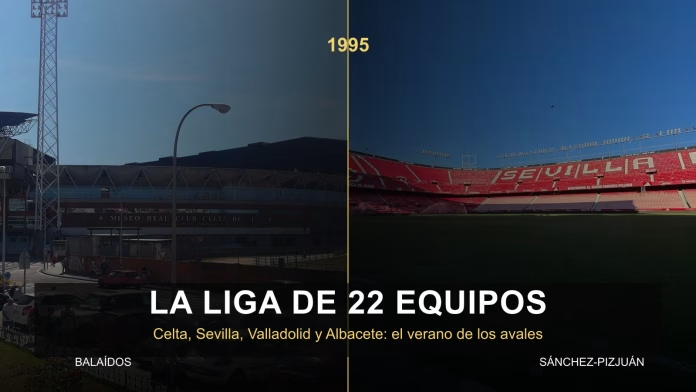
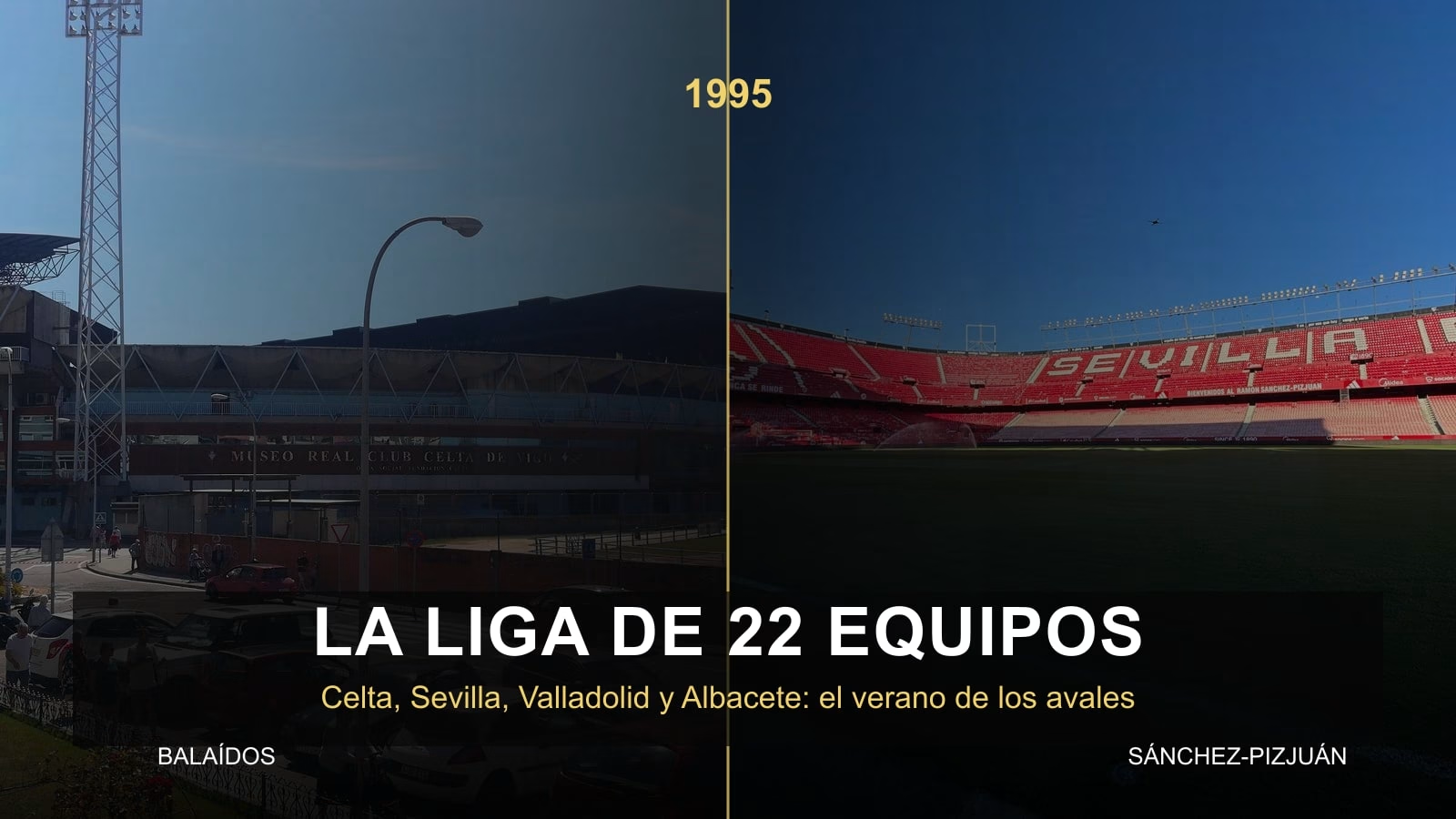
The social response was tremendous. In Seville and Vigo the news fell like a provocation. Thousands of fans gathered at Sánchez-Pizjuán and Balaídos, and the tension jumped from the stands to the town halls. RTVE reports that there were massive demonstrations on 2 and the 7 of August, with up to 25.000 people in Seville. AS also remembers that popular pressure as one of the keys to the subsequent turnaround.
football, when you really touch, It's not just classification. These are people leaving work and going to the stadium gate because they feel that something of theirs has been taken away from them.. The Sevilla player did not understand how a team qualified for Europe could fall to Second B due to an endorsement; The Celtic player did not accept that a season saved on the pitch was erased due to a bureaucratic error. And Valladolid and Albacete, meanwhile, They defended something also logical: If the law said that they had to play in the First Division, They could not be pushed aside again as if nothing had happened..
The Solomonic solution: all in
The Higher Sports Council became the arbiter of a problem that no longer had a clean solution. He 10 of August of 1995 recommended an expansion that would maintain Valladolid and Albacete without definitively executing the fall of Celta and Sevilla. He 16 of August, in an extraordinary assembly of the LFP, The First Division of 22 equipment. Days later it was confirmed that the League of 22 equipment would be maintained for 2 seasons to order the return to 20 clubs.
That was a victory for almost everyone and a defeat for the prestige of the system. Celta and Sevilla were still in First Division. Valladolid and Albacete too. The League avoided a judicial and social war with unforeseeable consequences. But the championship was touched by an uncomfortable piece of evidence: A sporting decision could depend on a table of documents, pressure in the street and an emergency meeting in the middle of August.
The season 1995-96: 42 journeys, 3 points for victory and a lot of noise
The League 1995-96 It was special for more reasons than one.. Not only did he have 22 equipment and 42 journeys; It was also the first season in Spain with 3 points for a win. According to RSSSF y BDFutbol, Atlético de Madrid was champion with 87 points in the year of the double, ahead of Valencia and Barcelona. Celta finished 11th with 52 points and Sevilla 12th with 48. Los 2 Clubs that had been on the brink of the administrative abyss saved the category on the field.
Valladolid also survived, 16º with 47 points. Albacete, instead, finished 20th with 42 and descended next to Mérida and Salamanca. Rayo had to play promotion and managed to save itself. That League of 22 teams was long, dense, irregular and fascinating: 42 journeys, stretched insoles, heavier schedules and a permanent feeling of a patched championship. In Colgados we have already told another very strange episode from that course: the match with the most penalties in the history of the League, that belongs precisely to that season 1995-96.
The closure of the anomaly in 1996-97
The second and last League of 22 was the 1996-97. Real Madrid was champion with 92 points and Barcelona finished 2nd with 90. Celta was 16th and was saved again. Seville, however, finished 20th and descended on the grass. Extremadura also went down, Hercules and Logroñés, while Rayo later fell in the promotion against Mallorca. RSSSF collects this closure with a table that explains the adjustment: had to reduce the First of 22 a 20 and the system pressed downwards.
That season also left a sentimental consequence for clubs like Extremadura., who had reached the elite in the midst of rare formats and multiple relegations. If you want to pull that thread, in Colgados we remember that Extremadura that played in the First Division, one of those borderline stories between dreams, the survival and toughness of professional football.
Why that botch still matters
The League of 22 equipment matters because it shows a truth that is sometimes forgotten: Spanish football was not always this perfectly packaged product, full of audits, salary limits, global brands and schedules thought out to the millimeter. There was a time not so long ago when a fax, an endorsement, A notary or a demonstration could alter the composition of the First Division. And we are not talking about regional football: we talk about Seville, Celta, Valladolid, Albacete, LFP, CSD and a competition that had just crowned Real Madrid champion. That is why the League of 22 teams remains a perfect scar to understand how modern football grew in Spain.
It also matters because it anticipates current debates. What weighs the most, the field or the norm? How far should an administrative punishment go?? What happens when applying the law to the letter generates a crisis greater than the original non-compliance?? In 1995 no one had an elegant answer. That is why the less clean and more practical answer was chosen.: enlarge the League and save time.
View from today, the story has something of a farce, some drama and some warning. The professionalization of Spanish football needed economic rules, Of course. But that case showed that poorly communicated rules, poorly executed or poorly assumed could explode in the middle of summer and leave the competition on the ropes.
The protagonists of the mess
- Sevilla FC: administratively punished for the endorsement, pressured by fans who did not agree to go down to Second B and finally saved by the expansion.
- Celtic RC: affected by a documentary error with his endorsements and protagonist of a huge mobilization in Vigo.
- Real Valladolid: descended in the field, but key in the legal battle for the regulations to be applied.
- Albacete Balompié: relegated after promotion against Salamanca, regained place in First and ended up dropping in sporting terms 1996.
- LFP and CSD: the organizations that had to convert an administrative crisis into a political and competitive solution.
Frequently asked questions about the League 22 equipment
When was there a League of 22 teams in Spain?
In the First Division there were 22 teams during 2 seasons: 1995-96 y 1996-97. In 1997-98 He returned to a League of 20 equipment.
Why was the League expanded to 22 equipment?
Because Celta and Sevilla were administratively relegated for not correctly presenting the guarantees within the deadline, while Valladolid and Albacete were readmitted. So as not to harm one or the other, the competition was expanded.
Who won the League 1995-96?
Atlético de Madrid won it with 87 points, in the season of the historic League and Cup double.
Which teams ended up being relegated after that anomaly??
In 1995-96 Albacete descended, Merida and Salamanca, while Rayo saved the promotion. In 1996-97 Extremadura went down, Sevilla, Hercules and Logroñés, and Rayo was relegated after losing promotion to Mallorca.
What relationship does it have with the current League??
The First returned to 20 equipment, but that expansion left an important legacy in Second, who happened to settle with 22 clubs. For the complete context of the league record, You can consult our review of achievements and data from the Spanish League.
Sources consulted
To prepare this article, data from RTVE, The country, Real Valladolid, AS, RSSSF 1995-96, RSSSF 1996-97 y BDFutbol. It also fits with other 90s football stories that we have already covered in Colgados, as the story of Peixe and the great pufos of the Spanish League.
Business: Colgadosporelfutbol.com
Featured Image Credit: Montage with Balaídos and Ramón Sánchez-Pizjuán, Celta and Sevilla stadiums in the summer of the Liga de 22 equipment. Base photos: Rion Tools / Wikimedia Commons, CC BY-SA 4.0; XLM Boi / Wikimedia Commons, CC0 1.0. Mounting: Colgadosporelfutbol.com.
Subscribe to get the latest posts sent to your email.

