

Last update 7 November, 2026 by Alberto Llopis
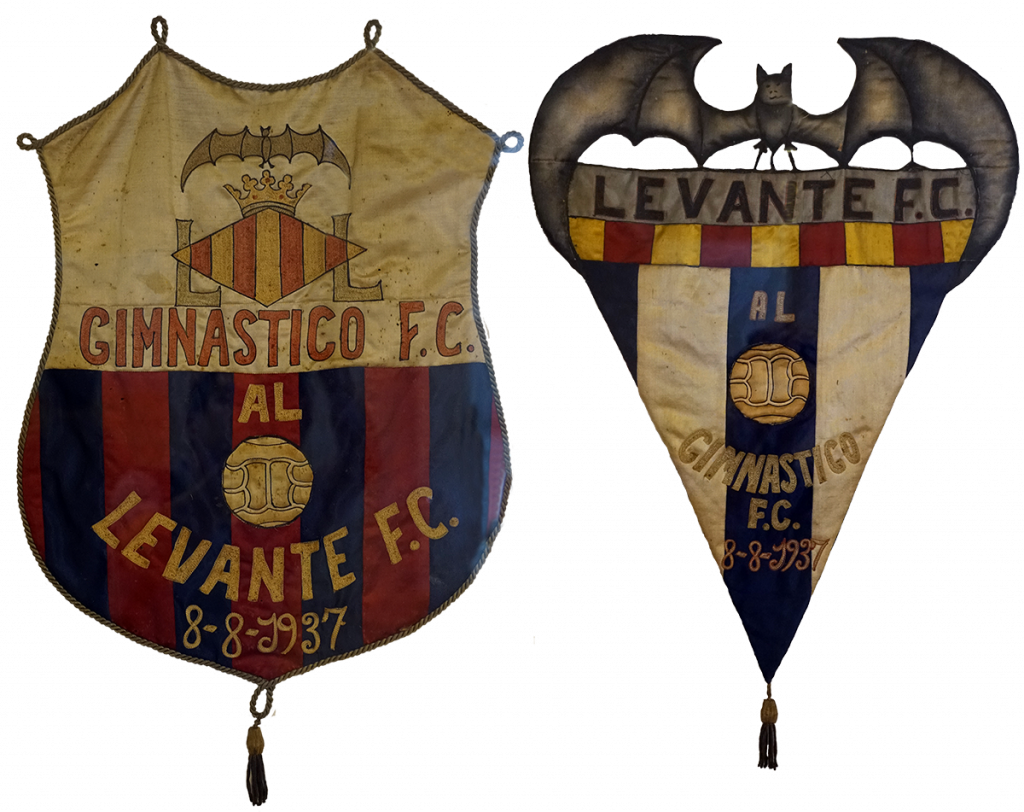
The Levante UD shirt is Barça because it inherited the Gimnastico colors, one of the two clubs that merged in 1939 to shape the current entity. The other was Levante FC, who dressed in black and white. The name and the shirt remain, therefore, parts of two different stories.
There is an important nuance: the fusion of 1939 did not immediately give way to the Barça team. During two seasons, The team was called Unión Deportiva Levante-Gimnático, o EXTENSION, and played red and white. The name Levante UD and the return to the Gimnástica colors came in 1941.
Two clubs behind the same shirt
Levante FC and Gimnástica shared roots in 1909, but they were not the same institution with two names. They had developed their own identities within Valencian football. The post-Civil War union did not suddenly erase that past.
He historical dossier of the Virtual Museum of Levante summarizes what they contributed to the merger: Levante FC put the footballers and Gimnástica, the Vallejo field, in addition to the blue and scarlet colors that would end up identifying the team.
Counting it only as a change of uniform falls short.. Behind there were two hobbies, two trajectories and the need to continue playing after a war. The t-shirt that today seems to be an indivisible hallmark was born from a union.
1939-1941: Levante-Gimnásico dressed in red and white
The UDLG played the seasons 1939-40 y 1940-41 with a red and white striped shirt. The club Museum explains, when studying the cards from those early forties, that combined the red of Gimnástica and the white of Levante FC. The collar incorporated blue.
That uniform was known as the cachirulo. It's not a detail lost without a trace: Levante himself recovered his memory for the second kit of the season 2024-25. Its colors had a historical explanation, They were not simply an aesthetic alternative to the azulgrana.
1941: the name of Levante and the colors of Gimnásico
In June 1941 The name Levante Unión Deportiva was adopted. With her the Barça player returned from Gimnástica. He campaign sticker album 1941-42 preserved by the Virtual Museum allows us to see that transformation on the shirts and on the shield.
This is the sequence that should be remembered: two clubs come together 1939, The resulting team wears red and white for two campaigns and in 1941 The combination of name and colors that we recognize as Levante UD is fixed. Confusing the date of the merger with the adoption of the Blaugrana eliminates that intermediate step.
Designs have changed since then., collars, manufacturers and sponsors. To explore this evolution is our review of the best jerseys in the history of Levante. The shape changes; the origin of the colors remains.
Does Levante wear Barcelona for Barcelona??
The most direct documented answer is that it takes him through the Gymnasium. Another different question is why that club originally chose blue and scarlet..
An article from the FC Barcelona website about Barça clubs relates that election to Narcís Basté, Barcelona Jesuit linked to the foundation of the Gymnastic, and with the similarity between the colors and the shields. However, that explanation poses a connection; This text does not provide a founding document that demonstrates that they were chosen as a tribute to Barça..
Besides, located in 1939 the adoption of the Barcelona player by Levante, while the club's own documentation distinguishes the red and white stage from 1939-1941. That is why it is convenient to separate what is proven from the hypothesis about a possible Barcelona inspiration.. The Gimnastic heritage is documented; that original motivation is not demonstrated by the cited article.
An identity that preserves two stories
The granota shirt does not need to look like that of another great to have a story to tell. The Gymnastic lives in its stripes; in your name, Levante FC. And between the two there is that brief red-and-white stage that usually disappears when everything is summarized too quickly..
It's the same shirt that, many decades later, accompanied the rise of Manolo Preciado's Levante in 2004, a story that we recover in the report about coaches who did not continue after being promoted. Knowing where it comes from does not take away the emotion of those memories: adds depth.
Subscribe to get the latest posts sent to your email.

