
Last update 16 April, 2026 by Alberto Llopis
The vision of a legend: Prosinecki analyzes Luis Enrique and modern football and opens up on Flashscore
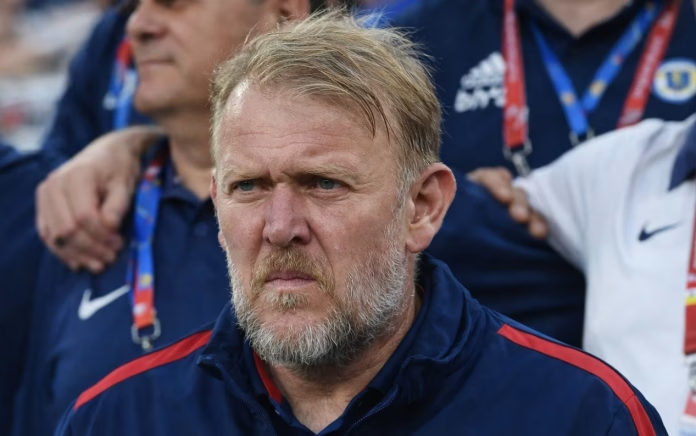
The Croatian former footballer Robert Prosinecki has granted an exclusive interview to Flashscore, in which, from the hand of the journalist Rafael Gomez, leaves one of the most interesting and profound reflections on current football, his career and key figures like Luis Enrique.
Throughout the conversation, 'Asks’ combine experience, self-criticism and football analysis, building a story that connects past and present of European football.
Prosinecki hoy: an ambitious project in Kyrgyzstan
Far from the spotlight of the big leagues, Prosinecki faces a different challenge as Kyrgyzstan coach. Your approach is clear: develop young talent and build a competitive team in the medium term.
Does not focus on immediate results, but in progressive growth. A vision that reflects a coach-trainer mentality, increasingly less common in modern football.
Red Star 1991: when football was more equal
One of the key moments of the interview is his memory of the European Cup title with Red Star in 1991.
Prosinecki is clear: such an achievement would be practically impossible today.
The main reason is the enormous economic difference between clubs. While in the years 90 there was more competitive equality, Currently, financial power directly determines who can aspire to win important titles..
This leaves a very powerful idea.: modern football has reduced real competitiveness in the elite.
His time at Real Madrid: talent conditioned by circumstances
Prosinecki's time at Real Madrid was marked by several factors that affected his performance.
On the one hand, constant injuries limited his continuity. For another, media pressure and personal context, especially the war in your country, influenced their adaptation.
“I arrived in the era after the 'Quinta del Buitre'. We were Hagi, Hugo Sánchez and me. In my first year at Real Madrid I had many problems with injuries. Era 1991 and everyone wanted to sign Robert Prosinecki and I wanted to come to Real Madrid. It was the best thing that could have happened to me Real Madrid. But the injuries weighed me down,. I don't even know why, but in the end when everyone tells you that you are made of glass, you don't play for a year and you're always injured, you are usually under great pressure. Also at that time there was a very ugly war in my country. My family was in Zagreb and I was worried about everything that was happening.”
I don't want it to sound like an excuse., but it was like that. Life happens and I spent three years at Real Madrid. I am a little more merengue than Barça because Madrid has been my best club.
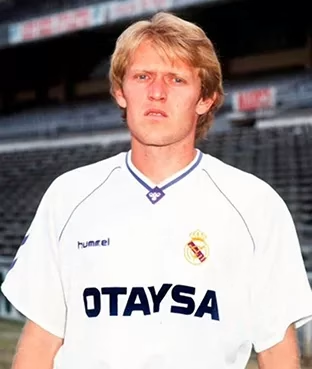
Even so, The Croatian does not renounce his career. He acknowledges that he did not reach his best level, but maintains a positive assessment of his stage.
Play in Madrid and Barça: a unique privilege
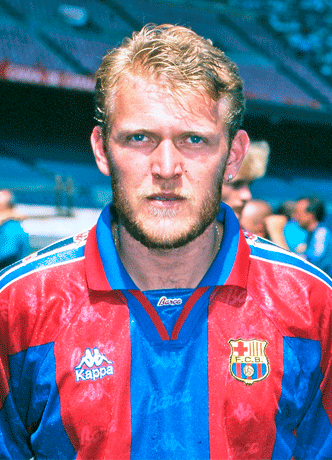
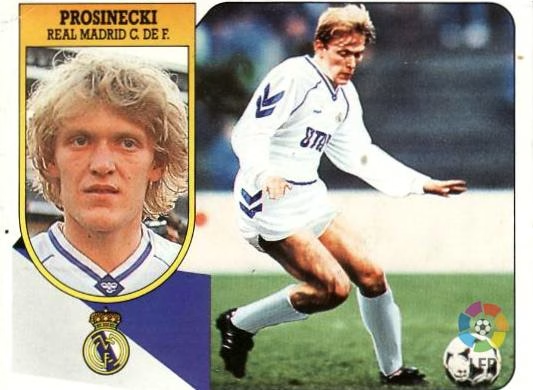
Prosinecki is part of a very small group of footballers who have played for both Real Madrid and FC Barcelona.
Far from controversy, He considers it a unique privilege in professional football. Having lived in two of the most demanding environments in the world allowed him to learn different ways of understanding the game and pressure..
Luis Enrique: personality, character and leadership
One of the highlights of the interview is Luis Enrique's analysis.
” Luis Enrique always had personality, I played with him for three years at Real Madrid. He is a player who came from Gijón, with a lot of personality, He was a worker and he was also a player who could act on all sides, from side, midfielder, in the center. Luis was a very good companion. Now, with Paris Saint-Germain he won the Champions League. He had an impressive season, won it all. He is a guy with a lot of energy, a great uncle.”
Prosinecki analyzes Luis Enrique and defines him as a footballer who already showed a strong personality from a young age.. A versatile player, hardworking and with a very strong competitive mentality.
As a coach, considers that he has known how to transfer those qualities to the bench, becoming a leader with character and a clear idea of the game.
The conclusion is forceful: Luis Enrique has not changed, He has simply evolved what he already was as a player.
Cruyff's influence on modern football
Prosinecki also highlights the figure of Johan Cruyff as one of the most influential coaches in history.
“He brought me to Barça. Cruyff is true that for me he is surely the best coach there has ever been.. It's different from all the others. First, as a player, He was a great player. With the Netherlands team. Later in Barcelona, At Ajax he did something special. Johan had his things, Johan has played football that does not leave you indifferent, that you either like it or not. But for me the best football is the one that keeps the ball.”
Highlights his obsession with detail and his key role in the implementation of possession football. A model that has marked subsequent generations of coaches.
His legacy is still very present in today's football and connects directly with technicians like Guardiola or Luis Enrique.
Today's football according to Prosinecki: talent vs context
Beyond proper names, The interview leaves a clear reflection on modern football.
Nowadays, individual talent is no longer enough on its own. Factors such as club structure, economic capacity and the competitive environment have a determining weight.
This reinforces a key idea: context is as important as talent in the elite.
An essential interview to understand current football
The Flashscore Interview, directed by Rafael Gomez, It is not just a review of Prosinecki's career.
It is an x-ray of modern football.
Among its main conclusions are:
- Today's football is conditioned by economic inequality
- Careers depend on both context and talent
- Great coaches are built from personality
- Cruyff's legacy continues to mark the current game
Subscribe to get the latest posts sent to your email.

