
Last update 4 February, 2026 by Alberto Llopis
The classified teams and a format that marks a before and after
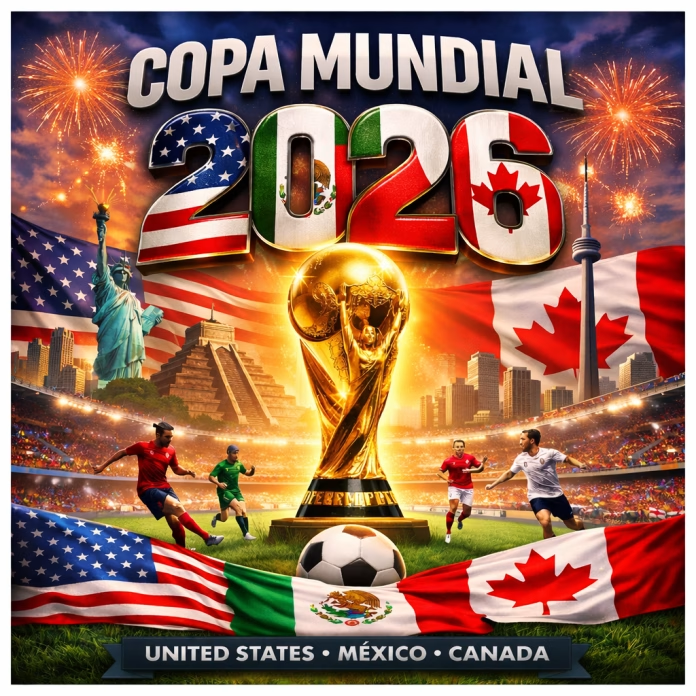
The World Cup 2026, which will be disputed in USA, Mexico and Canada, will be the first in history with 48 selections, a structural change that completely changes the way the tournament is organized, the dynamics of the group stage and, above all, the strategies of the participating teams.
The classification process, longer and more complex than previous editions, has allowed traditionally strong teams to secure their presence relatively early, while other emerging teams have surprised, taking advantage of the expansion of the World Cup quota.
Among those classified, the usual powers stand out, as Argentina, Brazil, France, England, Spain and Germany, but also teams that have grown in recent years thanks to younger generations or more solid sporting projects, like morocco, Japan or the United States. The geographical diversity of the tournament will also be a differentiating factor: playing in three countries means traveling more, adapt to different climates and manage efforts in a longer championship.
The new format, with groups of three teams in the first phase (before moving on to an expanded knockout phase), will force the teams to go out to compete from the first minute, no room for speculation. With only two games before the crossings, Any mistake can be decisive and any victory can be worth gold.. Besides, The media pressure and multicultural environment of the World Cup in North America will create a vibrant scene that will influence the performance of many teams..
For those who follow the tournament from an analytical approach, This context opens opportunities to evaluate quotas, selection trends and performance, integrating tools such as specialized platforms or football comparators, where it is natural to consult online football betting pages to follow statistics, form dynamics and match projections. In short, The qualification phase has not only defined the participants, but also the expectations and previous tensions of a World Cup that promises to be one of the most unpredictable in history..
Favorites to the title: between tradition, talent and new global powers
Talk about favorites in the World Cup 2026 involves looking at both historical factors and the most recent performance indicators. Argentina, current world champion, He arrives with the responsibility of defending the title in the midst of a generational transition that combines experienced players with young people who are breaking through with force..
The Albiceleste retains a recognized collective solidity and a versatile playing style, what keeps her as a natural candidate. France, meanwhile, continues to be a world reference: your individual talent, Its depth in all lines and its ability to reinvent itself tournament after tournament make it a threat to any rival. Although they lost the final in 2022, maintains an unmatched competitive structure and a generation that continues to expand with footballers capable of making a difference.
Brazil, always a favorite, He arrives at the World Cup wanting to break a historic drought and with extraordinary offensive potential. Your great challenge, as in previous editions, will be to find a balance between creativity and tactical discipline. England is experiencing one of the strongest moments in its recent history: semifinalist 2018, finalist in the Euro 2021 and a team full of young stars who already stand out in the European elite. Spain, with an increasingly vertical game, also appears as a candidate, especially if he manages to consolidate the offensive efficiency that he has sought in recent years.
However, One of the peculiarities of this World Cup is the emergence of teams that can no longer be considered “surprises”. Morocco, semifinalist 2022, has shown that its tactical discipline and collective strength can compete against any giant. Japan, with an increasingly mature game system, can also go far. The range of favorites expands, and that makes the forecasts much more uncertain than in previous editions. In a longer tournament, physical management, The depth of the bench and the ability to adapt to changing scenarios will be decisive factors.
Forecasts: trends, possible scenarios and competitive keys
Analysis of predictions for the World Cup 2026 must consider not only the individual level of each selection, but also the structure of the tournament and the type of rivals that can be found in each phase. Con 48 teams and an expanded schedule, physical resistance and player rotation acquire essential value.
From a performance point of view, It is expected that teams with extensive and balanced squads will reach the decisive phases with a greater advantage. Here teams like France enter the scene, England and Brazil, that have elite alternatives for each position. Argentina also presents a solid project, although his success will depend on how he handles the generational transition during the tournament. Another key aspect is the environment: play in massive stadiums, in different climates and with long journeys can significantly influence teams with less international experience.
In terms of competitive trends, It is likely that we will see a World Cup with many games played, less room for error and more surprises. The Asian and African teams, with increasing dynamics, could break analysts' predictions again, as has already happened in recent editions.
Regarding the possible scenarios, one of the most talked about is the probability that several European powers will cross paths sooner than expected due to the new format, which could open the way to less traditional teams. It is also important to consider the psychological impact: in such a media tournament, pressure can work for or against depending on the maturity of the group.
General forecasts indicate that France, Argentina, Brazil and England start with an advantage, but the margin of difference compared to teams like Spain, Portugal, Morocco or Japan has been considerably reduced.
This makes the World Cup 2026 in a tournament without an absolute favorite and with multiple possible outcomes. In conclusion, The upcoming World Cup will be a definitive test to evaluate who can best adapt to a new format, to a greater physical demand and a global scenario that has never been so balanced. It is precisely this mixture of uncertainty, talent and tactical evolution what makes the edition of 2026 be considered by many as the most open and interesting in recent decades.
Subscribe to get the latest posts sent to your email.

