
Last update 20 July, 2026 by football hung
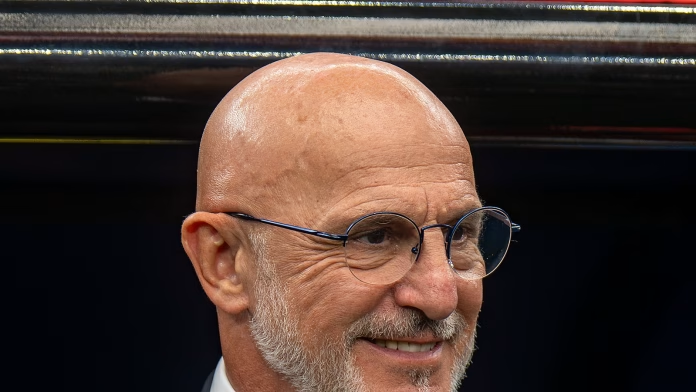
Luis de la Fuente, Spain coach, he is already world champion. The Riojan coach has led La Roja to win the 2026 FIFA World Cup™ after defeating Argentina by 1-0 in the final played on 19 July 2026 at New York/New Jersey Stadium. Ferran Torres scored in the minute 106 the goal that gave Spain its second star, 16 years after the eternal night of Johannesburg in 2010.
The victory against the current world champion places De la Fuente in a place reserved for very few. He is no longer just the coach who won the UEFA Nations League 2023 and the Eurocup 2024. He is the coach who has given Spain the second World Cup in its history and the man who has completed one of the most brilliant stages of Spanish football..
The data further enlarges his figure: according to FIFA, De la Fuente became, con 65 years and 28 days, the oldest coach to win a World Cup. Besides, Spain finished the tournament with only one goal conceded, the lowest record of a champion team in a World Cup edition, and Unai Simón closed the championship with 7 clean sheets. The second Spanish star was not the result of an isolated night, but of a team built with patience, defending, young talent and enormous competitive faith.
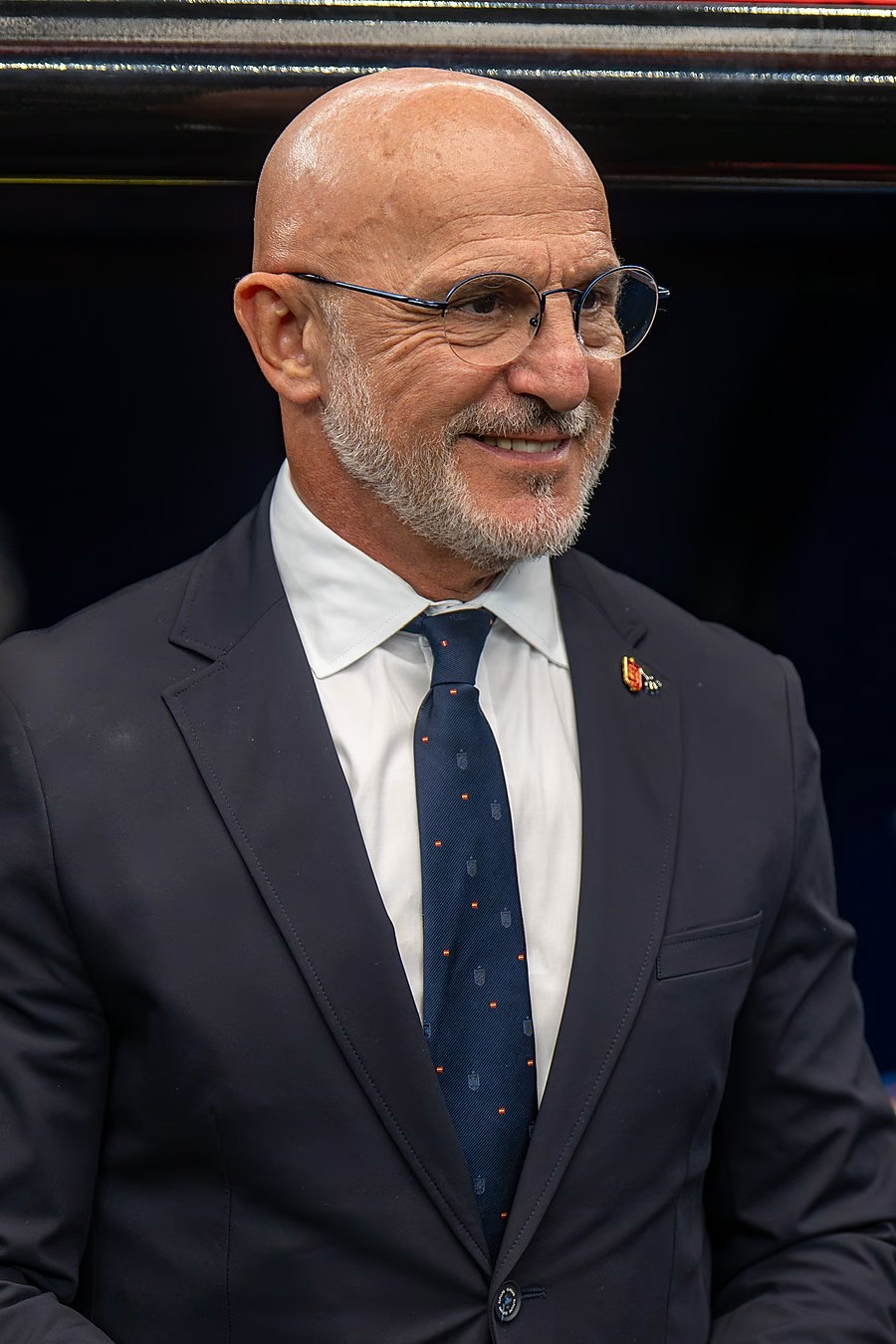
Luis de la Fuente, from Haro to the elite of Spanish football
Luis de la Fuente Castillo was born in Haro, The Rioja, he 21 June 1961. Before becoming national coach, He was a professional footballer. And that fact is not minor, because it helps to understand his way of directing: De la Fuente did not come to the bench from pure theory, but from the mud of competitive football, from the locker room, from the left side and from years of work.
As a player he trained in the Athletic Club environment and debuted with the red and white first team in 1980. own Athletic Club credits Luis de la Fuente 9 seasons and 234 Official matches with the club. It was defense, mainly left back, in a time of hard football, emotional and very recognizable, marked by Javier Clemente's champion Athletic. In San Mamés he was part of a generation that won 2 Consecutive leagues, the Copa del Rey and the Spanish Super Cup.
Later he played for Sevilla FC, where it maintained an important presence in the First Division, He returned to Athletic and closed his time as a footballer at Deportivo Alavés. UEFA summarizes that career as that of a player with more than 250 matches in LaLiga between Athletic and Sevilla. He was not a world poster star, but a reliable professional, competitive and with game reading. That discreet profile, constant and teamwork explains quite well to the coach who came later.
A coach trained away from noise
Before reaching the senior team, De la Fuente followed a path that was not very glamorous and very formative.. He trained Aurrera, He passed through Bilbao Athletic, He worked in quarry structures and directed Alavés in Second B. That stage did not have the media shine of the big benches, but it gave him something that is decisive today: training knowledge, patience to manage young people and a very clear idea of what it means to build a group.
His arrival at the Royal Spanish Football Federation in 2013 It was the turning point.. He started in the U-19 and grew from within. It did not land in the absolute as a fashionable name, but as someone who had seen many of the footballers who support Spain mature today. Rodri, Mikel Merino, Unai Simon, Fabián Ruiz or Dani Olmo belong to a generation that, one way or another, connect with that work of years. This continuity is one of the keys to the De la Fuente method..
The successes of Luis de la Fuente in the lower categories
The great value of Luis de la Fuente before becoming senior was converting youth talent into competitive teams. In 2015 won the U19 European Championship with Spain. It was not an isolated title, but the confirmation that the Riojan coach knew how to manage short tournaments, read young locker rooms and compete under pressure.
In 2018 won gold in the Mediterranean Games with the under-18s. One year later, in 2019, led Spain to the European under-21 title after beating Germany in the final. And at the Tokyo Olympics, disputed in 2021, led the team that won the silver medal. That route explains why the RFEF chose him after the departure of Luis Enrique: knew the present, the future and a good part of the dressing room that had to lead the new stage.
In Colgados we have already told how some footballers of that generation, as Mikel Merino and his key goals with Spain, have ended up being decisive in the current cycle. That connection between the inferior and the absolute is one of the most powerful arguments to explain the success of De la Fuente.
The absolute: Nations League, Euro Cup and World Cup champion 2026
Luis de la Fuente was named senior coach in December 2022, after the RFEF will bet on its natural continuity from the lower categories. His arrival did not generate unanimity. Part of the environment expected a more media name and part of the fans doubted whether a coach from the lower categories would have enough authority to direct the great figures.. The answer came in the field.
In 2023, Spain won the UEFA Nations League against Croatia in a final decided on penalties. It was the first major title for the men's team since the Euro Cup 2012 and served to break an emotional drought of more than a decade. In 2024, the jump was even greater: Spain won the European Championship in Germany playing with personality, band speed, pressure after loss and a very effective mix between young people and veterans.
The Euro Cup 2024 changed the perception of De la Fuente. Spain stopped looking like a team in reconstruction and once again felt like a favorite. In 2025 was runner-up in the Nations League after losing the final against Portugal on penalties, but the cycle was not broken. On the contrary: The group came out stronger towards the World Cup 2026.
In North America, Spain grew until it became world champion. FIFA highlighted the Spanish path to the final, including victory by 0-2 against France in the semi-finals, with goals from Mikel Oyarzabal and Pedro Porro. In the last game, Spain once again imposed its idea and defeated Argentina by 1-0 with a goal from Ferran Torres in extra time, as stated in the official FIFA report of the World Cup final 2026.
That goal by Ferran Torres is worth a star. The first was that of Vicente del Bosque in 2010, with Andrés Iniesta as hero in South Africa. The second already belongs to Luis de la Fuente, to a coaching staff that resisted initial doubts and to a generation that has known how to unite the heritage of Spanish football with a more vertical version, more physical and more mature.
The Source Method: equipment, calm and quiet authority
Luis de la Fuente's method is not explained only with tactical systems. Spain can play with deep wingers, high sides, midfielders who step into the area and very aggressive pressing, but the heart of the project is the management of the group. De la Fuente repeats a central idea: individual talent must be at the service of the team.
That message has penetrated because it does not sound imposed. Coming from someone who was not a superstar as a player, who had to earn his place through effort and who has spent many years dealing with young footballers. Your selection has stars, but don't live as a collection of egos. There is hierarchy, Yeah, but also distribution of responsibilities. That is why the bench has been so important in decisive moments of the cycle.
De la Fuente's Spain does not renounce the legacy of Spanish football. Links with the passing culture, reading and control that we explain in our article on The origin of tiki-taka and how Spain reinvented football, but adds more verticality, more external energy and a pressure more adapted to current football. It is not a copy of the equipment 2008-2012. It's an evolution.
Moral values, faith and a way of leading
One of the most personal traits of Luis de la Fuente is the naturalness with which he speaks about his values. He has publicly defined himself as Catholic and has explained in several interviews, including one granted to Alpha and Omega, that his faith brings him calm, security and balance. He does not present it as a tool to win games, but as an intimate part of their way of living and making decisions.
In the middle of the World Cup 2026, before the semi-final against France, He explained again that he prays every day, but not to ask for a result. That phrase pretty much sums up his way of separating faith from the scoreboard.: does not ask to win the rival, but maintain a consistent attitude, grateful and firm. In times of noise, controversy and overacting, That serenity has become part of his brand as a coach.
He has also spoken many times about humility, family, I respect, effort and common good. Those concepts may sound old in modern football., but in your case they work because they are linked to performance. Spain does not win just by being good people; wins because it competes well. But the internal coexistence, Trust and collective sense help keep talent from being dispersed..
The passion for the gym and a spectacular physical transformation
There is another Luis de la Fuente who also explains to the coach: the gym man, daily discipline and almost obsessive physical care. His body change drew attention since he came to the forefront of the senior team.. It wasn't just an aesthetic issue.. Media like Relief y The vanguard They have told how the knee injuries he suffered as a footballer pushed him to work his muscles more and to find a stable routine in the gym., healthy and mentally liberating.
De la Fuente likes to talk about “raising iron” naturally, but behind that phrase there is a very serious habit. His physical preparation has become part of his identity. To the 65 years, maintains an athletic image, strong and much more rejuvenated than the one it showed decades ago. It doesn't seem like a coincidence: the sport, the force, Orderly eating and the ability to disconnect are part of his way of facing life and the bench.
In an interview with Mundo Deportivo, asked about his routine, He responded that he spends “one hour every day” at the gym.. He also acknowledged that he is no longer looking for brands or exhibitions., but maintenance, health and balance. That idea fits perfectly with his public discourse: discipline, constancy, effort and head. In De la Fuente, the physique is not vanity; It is an extension of their way of understanding work.
This transformation also has a symbolic value. In a selection full of young talents, The technician projects an unusual energy for someone who has already surpassed the 60. His presence transmits vitality, self-care and consistency. Does not ask players to sacrifice from comfort: He also demands of himself. That silent authority, made from daily example, helps understand why the group follows him.
Inevitable comparison with Luis Aragonés and Vicente del Bosque
Each champion Spanish coach is inevitably connected with Luis Aragonés and Vicente del Bosque. Aragonés changed Spain's mentality in the Euro Cup 2008. Del Bosque prolonged that revolution until he won the World Cup 2010 and the Eurocup 2012. De la Fuente already belongs to that historic table: He is the coach who has given Spain its second world star.
In Colgados we have reviewed the figure of Vicente del Bosque as an icon of Spanish football, and the comparison helps to understand De la Fuente. Both transmit calm, They avoid excessive prominence and prioritize the stability of the group. The difference is that De la Fuente has had to rebuild the illusion in an era of faster football, more physical and much more exposed.
A Spain coach for a new generation
The great work of Luis de la Fuente may have connected generations. He has known how to give space to young people like Lamine Yamal, Nico Williams, Pedro, Gavi o Pau Cubarsí, but without breaking with competitively mature footballers like Rodri, Laporte, Morata, Oyarzabal o Merino. This mix is what sustains a team capable of competing in the most demanding scenarios..
The 2026 FIFA World Cup™ has confirmed that Spain once again rules world football. To follow the entire context of the tournament, you can consult in Colgados all World Cup squad lists 2026 and the guide on where to watch the World Cup 2026 on TV and online.
Luis de la Fuente has already won titles, has survived the initial doubt and has taken Spain to the top of the planet. His name fully enters the table of the great coaches in Spanish history. Not because of the noise, not because of the character, but for the facts: European champion, Nations League champion and world champion with Spain.
Frequently asked questions about Luis de la Fuente
Who is Luis de la Fuente?
Luis de la Fuente Castillo is a Spanish former footballer and coach born in Haro., The Rioja, he 21 June 1961. Since December 2022 He is the absolute coach of Spain.
Where did Luis de la Fuente play??
It was defense, mainly left back. He played for Athletic Club, Sevilla FC and Deportivo Alavés. With Athletic he won 2 Suspenders, the Copa del Rey and the Spanish Super Cup.
What titles has Luis de la Fuente won as a coach??
With Spain he won the U-19 European Championship 2015, gold at the Mediterranean Games 2018, the European under-21 2019, Tokyo Olympic silver, la UEFA Nations League 2023, the Eurocup 2024 and the 2026 FIFA World Cup™.
What values define Luis de la Fuente?
His speech revolves around the team, the effort, humility, solidarity, respect and responsibility. He has also spoken publicly about his Catholic faith as an important part of his personal life..
Does Luis de la Fuente go to the gym??
Yes. He has explained in several interviews that sport is a way of life for him. Your gym routine, born in part because of his knee injuries as a player, It has become one of the keys to your physical condition and mental balance..
Until when does Luis de la Fuente have a contract with Spain??
The RFEF announced in January 2025 its renewal as national coach until the Euro Cup 2028.
Sources consulted
RFEF, FIFA, official FIFA report of the World Cup final 2026, UEFA, Athletic Club, BDFutbol, Alpha and Omega, Revised Church, InfoCatholic, Relief, The vanguard, Sports world y Wikimedia Commons.
Subscribe to get the latest posts sent to your email.

