
Last update 29 July, 2026 by Alberto Llopis
The Spanish goals that changed history do not fit only on a scoreboard: explain times, styles, closed wounds and nights that changed Spain's relationship with the finals.
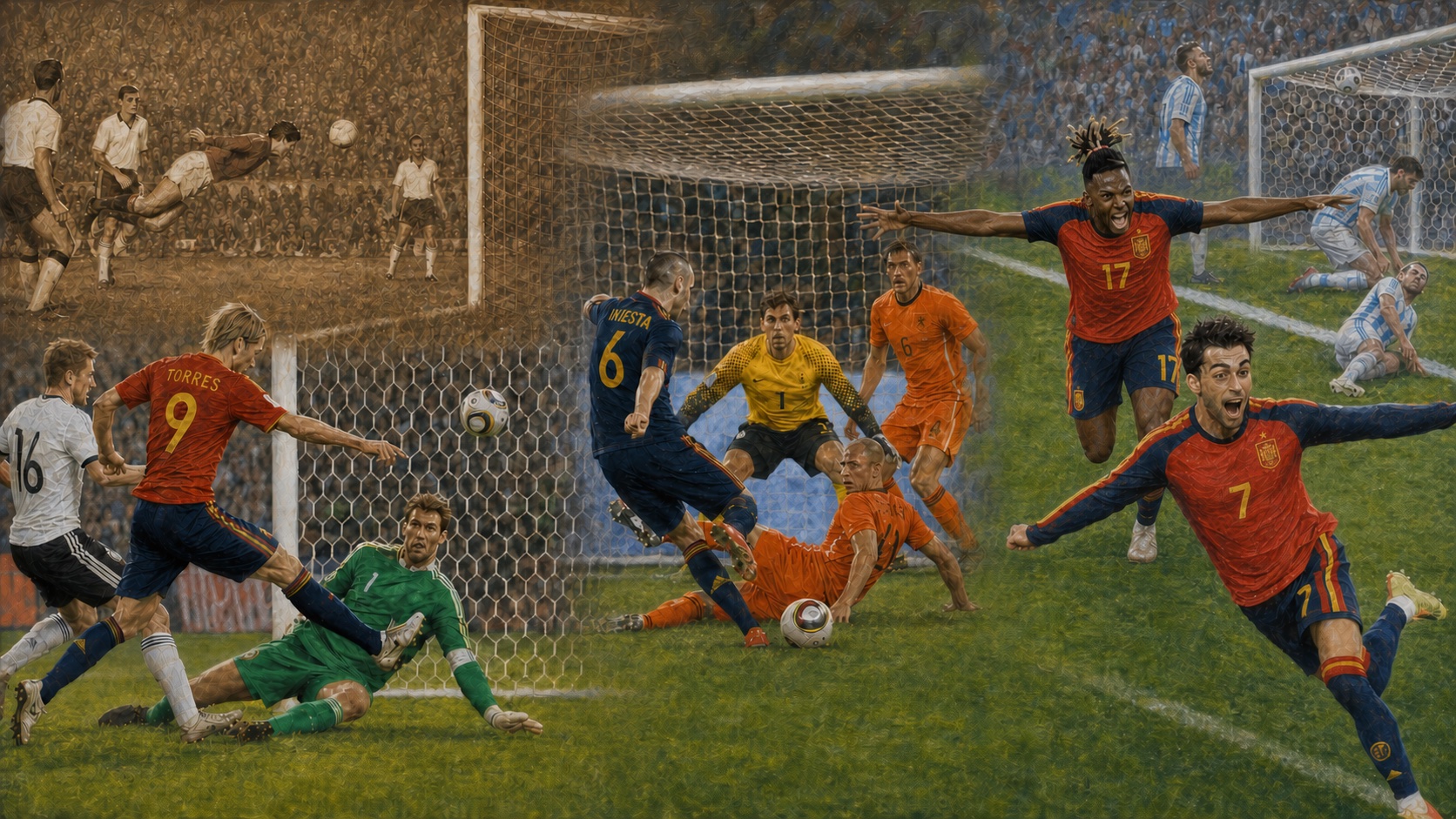
There are goals that are not a goal. They are a password. You say Marcelino and a Bernabéu appears in black and white. You say Iniesta and you hear an entire country go voiceless. You say Ferran Torres and we are no longer talking about a promising team, but from the Spain of the second star. The history of the Spanish team cannot be told only by titles, selectors or generations: It is counted by balls that cross a line and change the emotional size of a shirt.
This article is born from a very Colgadosporelfutbol idea: not staying in the clean data, but to go down into the beautiful mud of football. Spain has 4 Eurocopas, earned in 1964, 2008, 2012 y 2024, y 2 World Cups, 2010 y 2026. But before raising glasses there were goals that became a hinge. Some opened doors, others broke complexes and others directly changed the way in which Spain looked in the mirror. For the complete title map, you can cross it with him Updated honors of world champion teams and with the review of all the champions in the history of the World Cups.
Marcelino, 1964: the goal that removed the first lock
Before Iniesta, before Xavi, before Villa, before that Spain that seemed to play by memory, Marcelino Martínez Cao was there. He 21 June 1964, Spain won 2-1 to the Soviet Union in the final of the Euro Cup played at the Santiago Bernabéu. Pereda scored first, Khusainov equalized immediately and the match remained for many minutes in that area where finals begin to get old before their time.. Until Marcelino entered with a header in the minute 84 and turned a Pereda center into Spain's first great international shout.
That goal was not only the goal of the first European title. It was the first serious proof that Spain could also win a final. The RFEF has defined it for years as the goal that gave its name to a myth, and UEFA remembers that header as the action that decided the final against Lev Yashin's team. View from today, con 4 European Championships and 2 World Cups in your pocket, That scene seems like the first brick of everything that came after. But in 1964 Spain did not have a full showcase. I was hungry, doubts and a header goal that for decades was almost a football homeland.
Atom, Lord and Maceda: goals that also made memory
If we talk about Spanish goals that changed the story, You have to open a window for names that do not always appear in the quick summaries. Telmo Zarra scored against England in the World Cup 1950 and put Spain in the final group in Brazil. that goal, during years, It was one of the few giant postcards of the team in the World Cups. Before Spain learned to live in semi-finals and finals, Zarra had already left a mark that smelled like a feat.
Then there is the 12-1 in Malta, a night that belongs more to the popular imagination than to the cold logic of football. Juan Señor scored the goal that closed the qualifying comeback for the European Championship 1984 and turned an almost impossible tie into one of those stories that parents tell their children as if they had seen an eclipse. In that same Euro Cup, Antonio Maceda scored against West Germany and took Spain to the semi-finals. The title did not arrive, but the message does: Spain appeared again on big nights.
Towers in 2008: the goal that changed the tone of the conversation
Fernando Torres' goal against Germany in the Euro Cup final 2008 has something special: It doesn't sound like the end of a wait, but at the beginning of an era. Torres won the race, He hit the ball against Lehmann and Spain won its second Euro Cup, 44 years after Marcellin. The country no longer talked about bad luck, of referees, of the quarterfinals or that so Spanish thing of deserving more and returning ahead of time. He was talking about a champion.
That was a change of language. Luis Aragonés' team not only won a tournament; changed the self-esteem of Spanish football. He made it clear that talent could compete with fangs, that the touch could have poison and that a final did not have to be a forbidden room. No Towers in Vienna, It's hard to understand Iniesta in Johannesburg. The goal of 2008 It was the emotional prelude to 2010.
Villa, Puyol and Iniesta: the ladder to the first star
South Africa 2010 It is usually summed up in Iniesta, and it's normal. But before there was a staircase. David Villa was the man who kept Spain alive when the tournament was still full of mines. Scored against Honduras, Chile, Portugal and Paraguay, and each goal seemed to say the same thing: calm, we're still in. Then Carles Puyol arrived against Germany, with a header that didn't seem like a central one, but of destiny. That goal put Spain in the first World Cup final in its history.
And then Iniesta appeared. Minute 116, final against Netherlands, pass by Cesc, control, crossed blow and a shirt that no longer weighed the same. Iniesta's goal is the most important in the history of Spanish football because it changed a frontier. Before him, Spain was a great team that dreamed of being world champion. after him, Spain was world champion. That difference does not fit into a statistic. Fits in a celebration, in a dedication and in millions of people looking at a screen as if they had just seen something unrepeatable.
2012 y 2024: when Spain learned to win without asking for forgiveness
The Euro Cup 2012 was confirmation that that had not been a streak. Spain thrashed 4-0 to Italy in the final and closed a trilogy that still seems exaggerated: Euro Cup 2008, World 2010 and Eurocup 2012. Silva, Jordi Alba, Fernando Torres and Mata scored in kyiv, but the most symbolic goal was perhaps Alba's: lateral arriving as a winger, Spain accelerating from control, signature football without losing hunger.
In 2024, Mikel Oyarzabal scored the goal against England that gave Spain its fourth European Championship. UEFA picks up Spain as the first team with 4 European titles: 1964, 2008, 2012 y 2024. This information is very important to understand 2026. The Spain that reached the World Cup in North America was not a team that was looking to become someone again. She was the European champion, with a young generation and a history that already commanded true respect.
Mikel Merino, 2026: the goal that should not be left under the rug
In the tournaments that are won, There is always a goal that risks being hidden under the photo of the final. In 2026, that goal was Mikel Merino's against Belgium. Minute 88, close match, tension in the quarterfinals and Spain needing an exact hit to return to the semifinals of a World Cup for the second time in its history. Merino appeared and put La Roja in the noblest part of the tournament.
That much deserves its own place because champions are not made only in the finals. They are manufactured in awkward junctions, on short breathing nights, when the rival doesn't give you anything and the score starts to get serious. Merino was already building a special fame with Spain, and in 2026 he left one of those goals that don't always appear on the first poster, but without those there is no movie. You can read more in our profile Mikel Merino and his key goals with Spain.
Ferran Torres, minute 106: the second star
He 19 July 2026, Spain defeated 1-0 to Argentina in the World Cup final, played at the New York New Jersey Stadium. FIFA collects Ferran Torres' goal in the minute 106: center of Pedro Porro, Nico Williams' drop shot and first-time shot into the roof of the net. It seems like a simple move if you look at it quickly.. It wasn't. It was a final against the current champion, against Messi's Argentina, with the game in extra time and with the world watching.
Ferran did something that makes a footballer part of the memory: come off the bench and score the goal that decides a World Cup. Spain won its second World Cup and closed the circle that Iniesta had opened in 2010. But Ferran's goal does not copy Iniesta's. It has another scent. The one of 2010 it was liberation. The one of 2026 It was confirmation that Spain did not live on a memory, but of a competitive culture capable of reproducing itself under other names. To understand the scenario, It also fits our profile MetLife Stadium in New York/New Jersey and with the history of Luis de la Fuente, the second star coach.
Why these goals are not a list, but a biography
Marcelino, Atom, Señor, Maceda, Torres, Villa, Puyol, Iniesta, Oyarzabal, Merino and Ferran do not all belong to the same type of goal. Some win titles, others classify, others push a generation forward. But they all have something in common: they altered the conversation about Spain. After each, the selection was a little different.
The mistake would be to treat them as stickers. Football doesn't work like that. Marcelino's goal is worth it because Spain had nothing similar. The one from Torres is worth it because it ended 44 years of waiting. Iniesta's is worth it because it made a team that had always lived watching that peak from afar world champions.. The one from Oyarzabal is worth it because it made Spain the first team with 4 Eurocopas. Ferran's is worth it because he gave La Roja the second star and confirmed that the future was not a promise, was present.
Quick questions to locate the story
How many Euro Cups does Spain have??
Spain has 4 Eurocopas: 1964, 2008, 2012 y 2024. It is the team with the most titles in the history of the European tournament, according to UEFA.
What was Spain's first great historic goal in a final??
That of Marcellin against the Soviet Union in 1964. He scored in the minute 84 and gave Spain its first Euro Cup at the Santiago Bernabéu.
What goal gave Spain its first World Cup??
Andrés Iniesta's goal in the minute 116 from the South Africa final 2010 against Netherlands.
What goal gave Spain its second World Cup??
Ferran Torres' goal in the minute 106 against Argentina in the World Cup final 2026.
Official sources and videos
UEFA, Spain's records and titles in the Euro Cup. UEFA, end of 1964 and Marcelino's goal. RFEF, Marcelino and the Euro Cup goal 1964. FIFA, official chronicle of the Spain-Argentina final 2026. FIFA on YouTube, complete end of 2010. Spanish National Team on YouTube, Marcelino 1964. FIFA on YouTube, official summary of the final 2026. FIFA on YouTube, goal by Ferran Torres.
Signed: Colgadosporelfutbol.com
Subscribe to get the latest posts sent to your email.

