

Last update 7 November, 2026 by Alberto Llopis
There are stadiums that disappear from the map and continue to be the sentimental address of a team. Arsenal can still be seen at Highbury; al West Ham, between the houses of Upton Park; already Ajax, in that De Meer that seemed too small for everything that came out of there. The missing European stadiums tell a story that does not fit into the capacity data: that of the cities that changed and the fans who had to learn another way to go to football.
Not everything old was better, nor are all new fields a desert of emotions. Moving brought comfort, security and growth possibilities. But a stand is not replaced like a seat is changed.. You also miss the corner bar, the entrance through which parents and children passed and that corner from which it always seemed that the team attacked better. In these six fields, the last game was much more than a date.
Highbury: a stadium that is still recognizable when passing
Highbury did not end with a gray game. He 7 May 2006, Arsenal won 4-2 to Wigan and Thierry Henry scored three goals. It was a farewell worthy of a striker who had turned that field into his territory.. Then came the Emirates and a different life for the club.
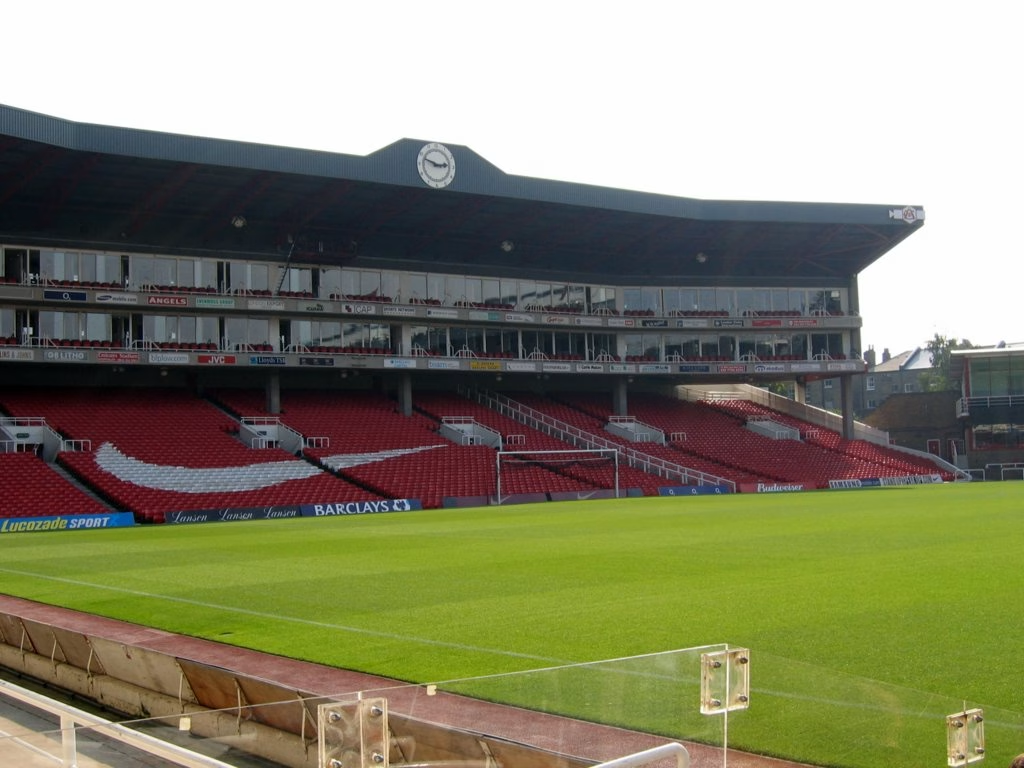
Arsenal had played there since 1913. The interesting thing is that Highbury was not completely erased: the facades of its East and West stands survived, integrated into a housing development. The playing field space became a garden. It can be discussed whether this transformation comforts or hurts., but it allows us to recognize the place where the stadium was.
Inside the missing fields, It is a particular case: football disappeared, not all its architecture. Its history deserves a longer stop on our tour of Highbury, Arsenal stadium converted into housing. Few moves leave a memory so visible and, at the same time, so strange.
Boleyn Ground: West Ham said goodbye with a comeback
The Boleyn Ground was also called Upton Park, and the two names still sound like West Ham. His first game came on 1 September 1904: and 3-0 al Millwall. Latest, he 10 May 2016, He once again had three local goals, although this time we had to suffer a lot more.
Manchester United took the lead after two goals from Anthony Martial. West Ham responded with headers from Michail Antonio and Winston Reid and won 3-2. There was no need to write a more theatrical ending. The club keeps the chronicle of that farewell, a night in which the result and the goodbye were mixed until they were inseparable.
After 112 years, The team moved to London Stadium and the old venue gave way to a residential transformation. A stadium wedged in the neighborhood was left behind, with the stands very close to the game. The house changed and the way to get to the game also changed.. That doesn't appear in a results table., but it explains a good part of the nostalgia.
Roker Park: one last afternoon of the League and another to say goodbye
A Sunderland, Roker Park was the home of the team between 1898 y 1997. His name continues to have a special weight in the memory of the club: It is not necessary to have stepped on its stands to understand that the public there was part of the landscape of the game.. The move to the Stadium of Light closed almost a century of football in the same place.
His farewell requires distinguishing two encounters that are often confused. The last league match was 3 May 1997: Sunderland won 3-0 al Everton. The subsequent closure came on 13 of may, with a friendly against Liverpool that ended 1-0. The rival made sense: Liverpool had also been at the opening of the stadium in 1898.

Roker Park was demolished and the site was converted into a housing area. It is one of those transformations that is difficult to imagine looking at an old photograph.: where the stands were accumulated, now there is another daily life. The image preserves what the city map can no longer show, including the most modest details: a cover, a fence, the distance to the grass.
The more: the small house of a huge Ajax
De Meer opened in 1934 and it was the home of Ajax until 1996. Estaba and Watergraafsmeer, east of Amsterdam, far from the scale of the stadium to which the club moved. Its size did not prevent it from becoming one of the fundamental directions of Dutch football..
There is an important nuance: Not all of Ajax's big European matches were played at De Meer. For meetings of greater demand, The club also used the Olympic Stadium. Attributing all those nights to him would be to enlarge the legend at the expense of history.. The true strength of the old field was in being the usual home, the scene of continuity and not only of extraordinary occasions.
After the move of 1996, The stadium disappeared and a residential neighborhood was built. He Ajax himself continues to recover his memory, even in their kits. De Meer remembers something we sometimes forget: The importance of a field is not always measured by counting its seats.
The old Luz stadium: the Cathedral that Benfica built
When talking about Da Luz it is worth clarifying which. The old Benfica stadium opened on 1 from December to 1954 and held their last meeting on 22 March 2003. The current venue inherited the name and status of the club's home, but it's not the same building.
The old Cathedral had a special relationship with its fans because its construction was linked to the effort and contributions of the Benfiquistas.. It wasn't just a stadium paid for for someone to play there: It was part of a collective work. He Benfica Museum preserves this history mobilization around the construction.
Its demolition paved the way for another stage. In Lisbon the name remained, but the stands and the scale of the place changed. That continuity has some promise.: that a new house can receive the memories of the previous one without pretending that they are exactly the same.
Stade du Ray: the Nice that fit within its neighborhood
The Stade du Ray was the home of OGC Nice between 1927 y 2013. The club places its inauguration on 30 of January of 1927 and also remember the names of Saint-Maurice and Léo-Lagrange associated with its history. That venue belonged to a form of city and football prior to the large contemporary sports complexes..

The arrival of the Allianz Riviera ended its life as the first team stadium. The Ray ended up demolished and its surroundings were transformed into a park. He Nice historical archive preserves the route of a field that accompanied the club during 86 years.
Your case does not need an ornate farewell to have strength. Enough the panoramic: the stands, the surrounding buildings and a playing field integrated into the neighborhood. These are details that allow us to understand why a relatively modest stadium can weigh so much in the memory of a fan..
What remains when the stands are gone?
Highbury kept part of his face; De Meer and Roker Park gave way to housing; the Ray made way for a park. There is no single way to close a stadium. There is no one way to remember it either.. Sometimes a facade remains and other times a name is enough for everything to reappear..
In Spain there are similar stories, that we go through separately in the missing stadiums of Spanish football. And there are pieces of that landscape that survive outside the stands: he Dart marker, the radio glued to the ear or the locker room tunnels for whom the game began to feel before stepping onto the grass.
Football continues elsewhere. Goals are celebrated again and a new generation ends up calling the next stadium home. But for those who were there, the old address never completely disappears. There is always a team attacking towards a goal that no longer exists.
Subscribe to get the latest posts sent to your email.


