

Last update 9 June, 2026 by Alberto Llopis
The market value of a footballer is not an exact science. It is an estimate built from multiple factors: sports performance, age, contract duration, position, league in which you compete, injury history, salary, projection, demand from other clubs and economic context of the market.
That's why, when a player is said to be “worth” 40, 60 o 100 millions of euros, We are not talking about an official or definitive figure. This is an approximate reference that helps compare footballers, analyze possible transfers and understand how the market moves.
However, one thing is the market value and a very different one actual transfer price. A club can pay above the estimate if it urgently needs to strengthen a position, if there are several teams interested or if the player has a long contract. You can also pay less if the player ends his contract soon., wants to leave or the selling club needs to deposit money.
in football, the final price does not depend only on talent. It also depends on the moment, of the negotiation and the power that each party has.
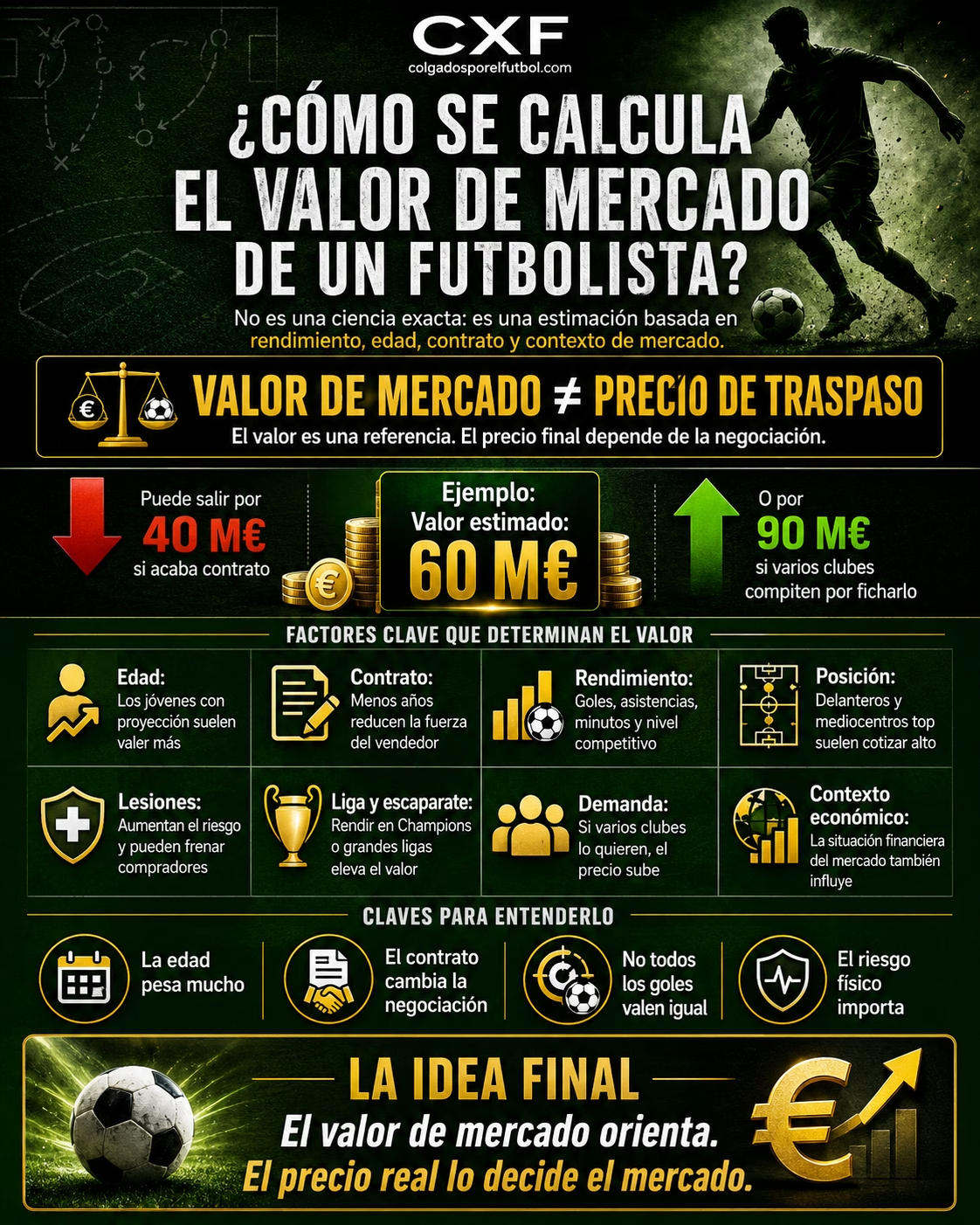
Market value and transfer price are not the same
Market value is a reference. The transfer price is the result of a negotiation.
A footballer can be valued at 60 million euros and end up leaving for 40 If the contract ends in one year, if you have lost prominence or if your club needs to sell. In the same way, may end up costing 90 millions if several clubs compete to sign him, if the seller has no need to get rid of him or if the player occupies a highly sought-after position.
The difference between value and price is best understood with a simple idea: the value tries to respond to How much should a player be worth under normal conditions?; the price corresponds to How much is someone willing to pay in a specific situation?.
That's why, two footballers with similar numbers can have very different prices. The market doesn't just buy current performance. Also buy age, potential, contract, brand, opportunity and risk.
Main factors influencing market value
| Factor | Impact on value |
|---|---|
| Age | Young players with projection tend to achieve higher ratings |
| Contract duration | How many more years remain, the selling club has the greatest power |
| Performance | Goals, assists, minutes, regularity and competitive level raise the price |
| Position | Forwards, unbalancing extremes, Dominant midfielders and top centre-backs are usually in high demand |
| League and competition | Performing in major leagues or international tournaments increases exposure |
| Injuries | A complex physical history can reduce demand and increase risk perception |
| Salary | A high chip can make the transfer difficult even if the player has a level |
| Projection | There is a lot of room for improvement, especially in under-23 players |
| Market demand | If several clubs are looking for a similar profile, the price may go up |
| Economic context | The financial situation of clubs and leagues directly affects operations |
Age and projection weigh a lot
Age is one of the most important elements in the evaluation of a footballer. A player of 20 years that already competes at a good level may be worth more than another of 29 with similar statistics, because the market not only values what it offers today, but also what can be tomorrow.
A young footballer with minutes in a competitive league, room for improvement and long contract is usually seen as an investment. The purchasing club not only pays for his immediate performance, but for several years of possible sporting and economic growth.
Instead, an older player can perform excellently, but its market value tends to be more limited by age, the possible loss of explosiveness, the expected length of your career and the difficulty of recovering the investment in a future sale.
This does not mean that older players have no market. They have it, especially if they offer leadership, immediate experience and performance. But normally its price depends more on the short term, while in young people the projection weighs a lot.
The contract changes the bargaining power
Contract duration is key. If a player has four or five years left on his contract, The selling club has more strength to demand a high amount. You are not obliged to sell and can more easily reject offers.
Instead, If the footballer has only one year left on his contract, the situation changes. The club runs the risk of losing him for free next season, so you may be forced to accept an offer lower than its estimated value.
Termination clauses also influence, renewal options, the premiums, training rights, future sale percentages and previous agreements between clubs or representatives. Two players with the same performance can have very different prices simply due to their contractual situation..
That's why, before interpreting a market figure, It is always advisable to look at how many years the player has on his contract and if there is pressure to sell or renew..
Performance: not all numbers are equal
Sports performance is the basis of any assessment, but not all the goals, assists or minutes have the same weight.
Marking is not the same 20 goals in a lower league than doing so in one of the major European competitions. Nor is it the same to stand out in low-demand matches as it is to do so in Champions League, in international qualifiers or with a powerful team.
The competitive context matters a lot. A player who maintains a high level against strong opponents usually generates more confidence than another with brilliant statistics in a less demanding environment..
Besides, modern analysis is not limited to goals and assists. Data such as participation in the game are also observed, pressure after loss, won duels, progressive passes, creation of chances, defensive efficiency, driving, decision making and consistency during the season.
A striker can be worth a lot for his goals, but also because of how he sets centrals, how he attacks spaces or how he improves his teammates. A midfielder may not have great offensive figures and, even so, be very valuable for his ability to order the game, overcome lines and balance the team.
Position also influences
The position of the footballer directly affects his price. In general, Offensive profiles usually reach higher prices because the goal is the scarcest and most expensive resource on the market.
Center forwards, overflow ends, Creative playmakers and midfielders capable of dominating matches are often in high demand.. Fast centre-backs have also become much more expensive., deep full-backs and midfielders with the ability to defend and build.
The value depends on the scarcity. If there are few players available with a certain profile, the price goes up. For example, A young striker who scores goals regularly in a strong league can have a much higher price than other footballers with similar performance., simply because that profile is difficult to find.
The tactical fashion of the moment also counts. If many clubs are looking for offensive full-backs, left-footed center backs, goalkeepers with good footwork or pressing midfielders, those profiles can increase in value quickly.
Liga, showcase and competitive reputation
The championship in which a footballer plays greatly influences his rating. Performing in a high-level league usually increases buyer confidence, because it is understood that the player has already demonstrated ability in a demanding competitive environment.
Media exposure also weighs. A good performance in the Champions League, Europa League, World, Euro Cup, Copa América or other international tournaments can boost the value of a footballer in a short time.
Big competitions act as showcases. A player who stands out in prime time matches can attract the attention of clubs that did not previously have him as a priority.
However, the showcase can also generate overvaluations. A big tournament that lasts a few weeks can greatly increase the public perception of a footballer, although it does not always reflect its real regularity throughout a season.
Injuries and physical risk
Injuries do not automatically eliminate the value of a footballer, but they do increase uncertainty. A high-quality player can continue to have a market even if he has suffered significant injuries., but the clubs will analyze his medical history in more detail, your age, your position and your ability to recover.
A complicated physical history can reduce demand, stop a trade or cause the final price to be lower. It can also affect the structure of the contract, with variables for games played, minutes played or performance.
That is why medical examinations are decisive before closing a signing.. They not only serve to detect current problems, but also to evaluate future risks.
In high cost operations, physical risk can change everything. A club may be willing to pay a high amount for a healthy and regular player., but not by one that offers doubts about its availability.
Salary, agent and total cost of the operation
Market value should not be analyzed in isolation. For a club, signing a player does not mean only paying the transfer fee. You also have to consider salary, premiums, commissions, taxes, contract duration and possible variables.
Sometimes a player has a high market value, but his salary makes the operation difficult. If you charge too much, few clubs can assume the full cost. In other cases, the transfer may seem cheap, but the salary and commissions make the operation much more expensive.
That's why some footballers go free and are still expensive. There is no transfer payment, but there may be a high signing bonus, a very high chip and important commissions.
From a financial point of view, clubs calculate the overall cost of incorporation, not just the publicly announced figure.
Tactical adaptability and playing style
The footballer's style also influences his market. A player capable of adapting to different systems, positions and competitive rhythms tend to interest more clubs.
For example, a winger who can play on both sides, a central defender who can act in defense of three or four, or a midfielder who combines physical, pass and tactical reading will normally have a broader market than a specialist highly dependent on a specific context.
Adaptability reduces risk for the buyer. The more coaches, systems and leagues can fit a player, the greater your potential demand.
Tactical intelligence is also valued, competitive personality, defensive discipline and the ability to perform under pressure. Not everything appears in the statistics, but everything influences the final assessment.
Demand, market need and timing
The need of the buyer and the strength of the seller can completely change a transaction.
A club that has just lost its starting striker, who needs to qualify for the Champions League or who urgently need to strengthen a position may pay more than expected. Urgency makes it more expensive.
Instead, a selling club with financial problems, excess players in a position or need to meet financial objectives may accept less money. The need to sell makes it cheaper.
The market moment also influences. In the last days of a transfer window, prices can change a lot. If a club arrives late, You have few alternatives and need to close an operation, the seller can tighten his conditions.
That is why the transfer market does not behave like a fixed table. It's dynamic, emotional and strategic.
Why a player may be worth more than his statistics indicate
There are footballers whose value cannot be understood just by looking at basic numbers.. A center back may not score goals or give assists, but be key for your leadership, speed to space, ball exit and ability to defend away from the area.
A midfielder can have few striking actions, but sustain the entire team system. A striker may not be the top scorer, but generate spaces, press, set defenses and improve the performance of attackers playing around you.
There are also intangible elements: leadership, mindset, professionalism, international experience, ability to compete in big games and fit into demanding locker rooms.
Clubs are trying to measure more and more aspects, but part of the value still depends on the sporting interpretation.
Why a footballer's market value can rise or fall quickly
The market value of a footballer can change in a few months. Some situations that usually cause increases are:
- Explosion of performance in a major league.
- Good role in Champions or international competitions.
- Debut or consolidation with the national team.
- Renewal of contract with the current club.
- Public interest of several big clubs.
- Lack of similar players in the market.
It can also be lowered for clear reasons:
- Recurrent injuries.
- Loss of ownership.
- Prolonged poor performance.
- Old age.
- Contractual disputes.
- Near end of contract.
- Relegation or financial problems of the club.
Valuation is not a permanent photograph. It is an estimate that changes with performance, context and expectations.
How to correctly interpret market value
To understand well the market value of a footballer, It is advisable not to be left alone with a figure. It is advisable to analyze the complete context.
A good analysis should answer several questions:
- How old is the player?
- How many years of contract do you have left??
- What league do you compete in??
- What has been your recent performance??
- Do you have a history of injuries?
- What clubs might be interested??
- Is your position scarce or abundant in the market?
- Does your salary facilitate or complicate an operation?
- Does the selling club need money?
- Does the player want to leave or renew??
Only with this information can you better interpret if a valuation seems high, low or reasonable.
Market value does not mean mandatory price
The most common mistake is to think that market value works like a price tag.. It's not like that.
A player valued at 50 million does not have to be sold for exactly that amount. You can go out 30, by 70 or not go out. It all depends on the negotiation.
Market value serves as guidance, but the final price depends on the specific circumstances of each operation. In soocer, context can matter as much as performance.
Therefore the figures should be read as references, not as absolute truths.
Common mistakes when searching for this information
The most common mistake is to stay with an isolated figure without understanding what is behind it. In football almost everything depends on the season, country, contract, competition, regulation, club need and market moment.
Another common mistake is to compare players only by goals or assists.. Statistics are important, but they do not fully explain the value of a footballer. There are positions, roles and contexts that are not reflected well in the simplest numbers.
It is also common to use old data without checking. In the transfer market, an injury, a renewal, A good run or the interest of a big club can change the valuation in a very short time.
That is why it is better to explain the entire concept than to limit yourself to a short answer.. A figure without context can be useful as a starting point, but not as a definitive conclusion.
Frequently asked questions about the market value of a footballer
Who decides the market value of a footballer?
There is no single authority that decides the market value of a footballer. The figures are constructed from estimates from specialized databases, market analysis, sports performance, contractual situation, age, position and demand of clubs.
Agents also influence, sporting directors, analysts, specialized media and recent operations of similar players.
Does Transfermarkt indicate the official price of a player?
No. Transfermarkt offers a market estimate, but it is not an official or binding price. Your figures can serve as a reference, but no club is obliged to sell or buy for that amount.
The real price of a transfer depends on the negotiation between clubs, the player's will, the contract, salary and market context.
Why does a club pay more than the estimated value?
A club may pay more than the estimated value for several reasons: urgent need, competition with other buyers, long player contract, lack of similar footballers or confidence in their future potential.
The timing of the operation may also influence. In a transfer window with few alternatives, the price can rise quickly.
Why a player can go for less than his market value?
It can happen if the contract ends soon, if you want to go out, if it has lost prominence, if the club needs to sell or if there are not many interested buyers.
Your salary can also influence. A very high salary reduces the number of clubs capable of assuming the operation.
Does age always reduce the value of a footballer?
Not always, but it does tend to limit it. A veteran player can have a lot of sporting value, especially if you perform at a high level, but his market value is usually lower than that of a young footballer with projection and the possibility of resale.
The market pays both current performance and future potential.
Do injuries make a player lose all his value?
Not necessarily. Depends on the type of injury, the age of the footballer, your physical history, your recovery and subsequent performance.
A player with specific injuries can maintain a high value if he competes well again. Instead, Recurring injuries can reduce demand and make clubs negotiate more cautiously.
What positions usually have the highest market value?
Attackers usually achieve very high ratings because the goal is one of the scarcest resources in football. Unbalancing extremes are also highly valued, the complete midfielders, fast centre-backs and goalkeepers with great footwork.
The key is not just the position, but the scarcity of the profile. The fewer players there are with those characteristics, the higher the price can be.
Does the market value change during a season?
Yes. It can go up or down depending on performance, minutes played, the lesions, the interest of other clubs, contract renewals or performance in important competitions.
A great performance in an international tournament or in the Champions League can increase the visibility of a player and raise his price.
What is the difference between termination clause and market value?
The termination clause is an amount established in the contract that allows the player to be released if that amount is paid. The market value, instead, It's an estimate.
A player may have a release clause 100 million and a market value of 40, or the other way around. The clause does not always reflect the real price that a club would be willing to pay..
Recommended sources to compare data
To update this type of content before publishing it, It is advisable to review specialized and official sources such as:
- Transfer market, for estimated values and market evolution.
- FootballTransfers, for estimates, transfer rumors and analysis.
- CIES Football Observatory, for valuation and market studies.
- FIFA TMS, for global transfer reports.
- UEFA, for economic and financial reports of European football.
- Statistical bases like FBref, Opt for a StatsBomb, when you need to contextualize performance.
Table of Contents
ToggleSubscribe to get the latest posts sent to your email.

