
Last update 23 May, 2026 by Alberto Llopis
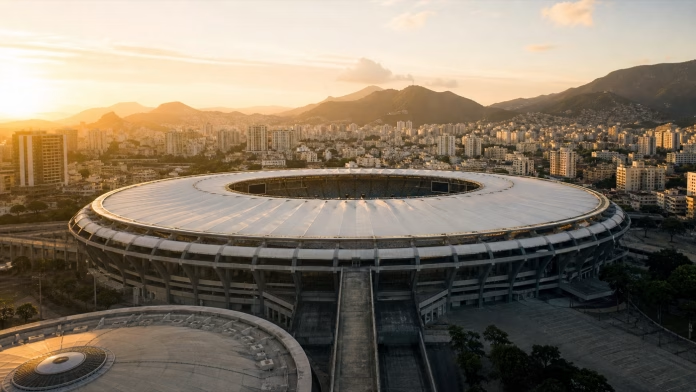
Maracaná is much more than a stadium: It is one of the great temples in the history of football. Inaugurated in 1950 for the World Cup in Brazil, el Estádio Jornalista Mário Filho, universally known as Maracaná, It has been a scene of joy, sports tragedies, impossible records and nights that are still part of the collective memory of the ball.
Located in Rio de Janeiro, the Maracaná was born with a vocation for greatness. Its popular name comes from the river and the Maracanã neighborhood, an area of the city marked by the presence of birds known by that name. Its official name, Jornalista Mário Filho Stadium, pays tribute to the Brazilian journalist who strongly defended the construction of a large stadium for the World Cup 1950.
The origin of the Maracaná
Brazil needed a venue at the level of the World Cup 1950. The country had been waiting for years to organize a World Cup and Rio de Janeiro, then symbolic capital of Brazilian football, It had to have a monumental stage. This is how the Maracaná was born, a stadium designed to bring together crowds and show the world the Brazilian passion for football.
For decades it was considered the largest stadium on the planet. In its first years it could receive audience numbers that are unthinkable today, when there were still large standing areas and safety regulations were very different from today. Over time, the reforms, The installation of seats and modern demands reduced its capacity, but not his legend.
The Maracanazo, the wound that made the stadium eternal
The history of the Maracaná was marked forever 16 July 1950. that day, Brazil only needed a draw against Uruguay to become world champion. The entire country took the title for granted, but Uruguay won 1-2 and turned that afternoon into one of the biggest surprises in the history of football.
That match went down in history as the Maracanazo. More of 170.000 official spectators, and some estimates higher than 200.000, They attended a defeat that forever changed Brazil's relationship with its team. Since then, Maracaná is not just a stadium: It is also a word that sums up pressure, drama and football in its purest form.
A stadium of records and great nights
The Maracaná brought together masses that are difficult to imagine in today's football.. Inputs greater than the 190.000 spectators at big Brazilian football matches, especially in classics between Flamengo and Fluminense, two clubs deeply linked to the venue.
It was also home to unforgettable international moments. Decisive matches of the Confederations Cup were played there 2013, the World Cup final 2014 between Germany and Argentina and key matches of the Rio Olympic soccer tournament 2016. Besides, hosted ceremonies of the Pan American Games 2007 and the Olympic and Paralympic Games of 2016.
Pelé and the goal 1000
If there is a name that accompanies the history of the Maracaná, it is that of Skin. O Rei debuted with the Brazilian team on this stage, He played memorable matches there and scored the famous number one goal at the Maracaná. 1000 of his career, he 19 November 1969, with Santos against Vasco da Gama.
That penalty converted by Pelé turned a Brazilian league night into a world event. The image of the king of football lifted by his teammates on the Maracaná grass remains one of the most recognizable photographs in the history of sport..
The remodeling of the Maracana
The stadium has changed a lot since its inauguration. The major reforms modernized the stands, the cover, access and security. The most profound transformation came before the World Cup 2014, when the Maracaná adapted to the international standards required by FIFA.
Currently its capacity is around 78.838 spectators, a figure much lower than that of its peak times, but enough to maintain it as the largest stadium in Brazil and one of the most recognizable venues in world football..
Curiosities of the Maracana
- Its official name honors the journalist Mário Filho, a key figure in the defense of its construction.
- Flamengo and Fluminense have turned the stadium into one of their great football homes.
- Besides football, has hosted concerts by artists such as Frank Sinatra, Madonna, Paul McCartney y los Rolling Stones.
- It was the scene of two World Cups separated by 64 years: Brazil 1950 and Brazil 2014.
- The Maracanazo remains one of the most studied episodes in the emotional history of football.
Why the Maracaná remains a myth
There are modern stadiums, comfortable and spectacular. But very few have the historical burden of the Maracaná. There the greatness of Brazil mixes, the trauma of 1950, the figure of Pelé, the carioca classics, the international finals and the memory of several generations of fans.
That's why, although he is no longer that giant capable of overcoming the 200.000 spectators, The Maracaná continues to be one of the sacred names of football. A place where the ball weighs different and where each stand seems to keep a story.
Frequently asked questions about the Maracana
Where is the Maracana?
The Maracana is in Rio de Janeiro, Brazil, in the neighborhood that bears the same name. Its official address is next to the Maracanã area, in one of the best known areas of the city.
What is the official name of the Maracana??
Its official name is Estádio Jornalista Mário Filho, in homage to the Brazilian journalist who promoted the idea of building a large stadium for the World Cup 1950.
How many people can fit in the Maracana??
After its modern renovations, The capacity of the Maracaná is around 78.838 spectators. In the past it housed entrances exceeding 170.000 official spectators.
What was the Maracanazo?
The Maracanazo was Brazil's defeat against Uruguay by 1-2 in the World Cup 1950. Brazil needed to draw to be champion, but Uruguay came back and won the title in the Maracaná.
What teams play at the Maracaná?
Flamengo and Fluminense are the clubs most associated with the stadium. It has also been used by the Brazilian team and by other Rio teams at different times..
Subscribe to get the latest posts sent to your email.

