
Last update 14 June, 2026 by Alberto Llopis
Las historic overtimes in the World Cups they have something special: They condense football in its most extreme state. It is no longer played only with technique or tactics. Played with tired legs, cold head and unbearable pressure.
And there are World Cup matches that cannot be explained only by the result.. They are explained by fatigue, the fear, the tension and those 30 extra minutes in which a team can achieve glory or disappear from history. Extra time is the cruelest territory of a World Cup: there is no more physical margin, the changes weigh, The errors get bigger and each split ball can change a generation.
At the World Cups, extra time has decided champions, has broken favorites, has created unexpected heroes and has left some of the most memorable scenes in football. The one who played the best during the game does not always win. 90 minutes. Sometimes the one who resists better for half an hour wins..
This is a selection of historic overtimes in the World Cups, matches that changed in 30 minutes and that continue to form part of the universal memory of football.
Historic overtimes in the World Cups
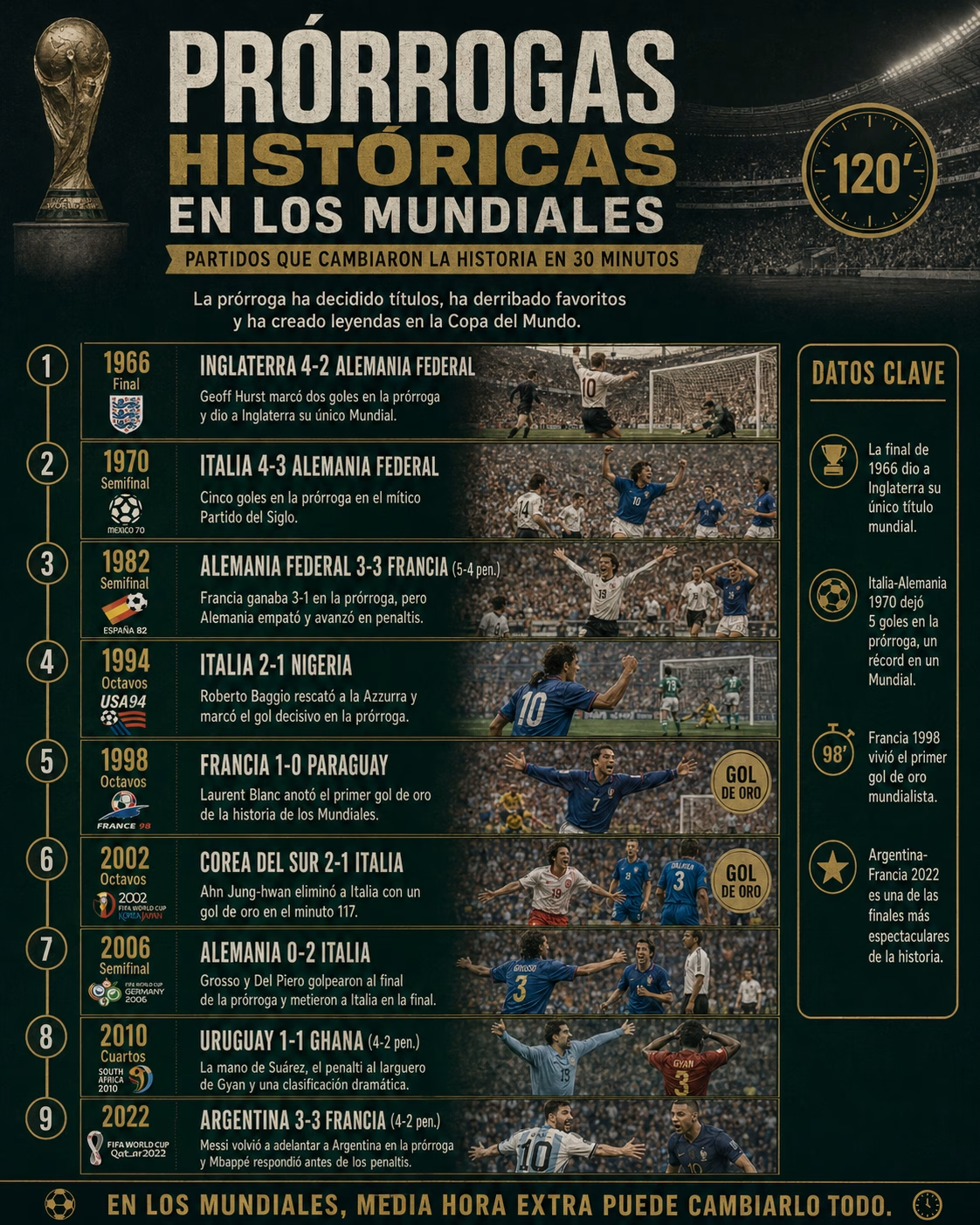
England 4-2 Federal Germany, 1966: the extra time that crowned Wembley
The final of the World Cup 1966 It is one of the most famous extensions of all time. England and West Germany arrived at the minute 90 with tie, after Wolfgang Weber's goal near the end of regulation time. Geoff Hurst appeared in extra time to score two more goals and close the game. 4-2 at Wembley. FIFA collects the English scoring sequence with Hurst in the minutes 18, 101 y 120, and Martin Peters in the 78.
The match was marked by the famous third English goal, Hurst's shot that hit the crossbar and whose validity is still disputed decades later. But, beyond the controversy, that extension changed history: England won their first and only World Cup to date, and Hurst had an unrepeatable performance in a final.
Those 30 minutes turned Wembley into a myth. Without that extension, the story of English football would be completely different.
Italia 4-3 Federal Germany, 1970: five extra goals and the “Match of the Century”
If there is an extension that seems written for the cinema, It's the semifinal of the World Cup in Mexico 1970 between Italy and West Germany. The game arrived 1-1 at the end of the 90 minutes, but in extra time madness broke out: five goals in half an hour. FIFA remembers that those five goals in extra time are still a record in a World Cup match.
Germany took the lead with Gerd Müller, Italy responded with Tarcisio Burgnich and Gigi Riva, Müller tied again and Gianni Rivera scored the 4-3 definitive. It was an emotional roller coaster at the Azteca Stadium, a match so wild that it ended up being dubbed the Match of the Century.
The extension not only decided a finalist. Elevated the game to legend. Italy went to the final, Germany fell on its feet and the World Cup won one of its most dramatic chapters.
Federal Germany 3-3 France, 1982: the night of Seville and the first great trauma from the penalty spot
The World Cup semi-final in Spain 1982 between France and West Germany is one of the most intense and painful extensions in history. The match went to extra time with a tie. 1-1. France got 3-1 with goles by Marius Trésor and Alain Giresse, and seemed to have the final in hand. But West Germany reacted with Karl-Heinz Rummenigge and Klaus Fischer to force the 3-3. FIFA remembers it as one of the great World Cup nights, with France coming close to the final after taking a two-goal lead in extra time.
The match ended in penalties, and there Germany won 5-4. Besides, It was the first penalty shootout in history in a World Cup, according to Guinness World Records.
That extension changed the destiny of one of the best French generations. It also confirmed something that football would never forget.: in a World Cup, not even a 3-1 in extra time guarantees survival.
Italia 2-1 Nigeria, 1994: Roberto Baggio against abyss
Italy was on the verge of being eliminated in the second round of the World Cup in the United States 1994. Nigeria won 1-0 and the Azzurra played with ten after the expulsion of Gianfranco Zola. But Roberto Baggio equalized in the minute 88 and sent the game to extra time. Over there, in the minute 102, He appeared again to convert a penalty and qualify for Italy. FIFA preserves that Baggio goal in the 102 as one of the key moments of that World Cup.
That extension was decisive because it changed the Italian tournament. If eliminated, went to quarters. Then it surpassed Spain, defeated Bulgaria in the semi-finals and reached the final against Brazil.
Baggio would end up remembered for the missed penalty in Pasadena, but before that image there was another truth: without its extension against Nigeria, Italy would not have even reached the final.
France 1-0 Paraguay, 1998: the first world cup golden goal
The World Cup in France 1998 introduced a new tension: the golden goal. If someone scored in extra time, the game ended at that moment. In eighths, France suffered a lot against Paraguay and José Luis Chilavert. The match was headed to penalties until Laurent Blanc scored in the minute 114.
Guinness World Records recognizes Blanc's goal against Paraguay, he 28 June 1998, as the first golden goal in the history of the World Cup finals.
France not only avoided the shootout. Survived an uncomfortable night, He advanced in his World Cup and ended up lifting the Cup in Paris. That goal from Blanc showed that an extra time could end without warning: a finish, a celebration and immediate end.
South Korea 2-1 Italia, 2002: Ahn Jung-hwan and the blow to the giant
Four years later, The golden goal once again left a historic image. In it Korea and Japan World 2002, Italy fell to South Korea in the round of 16. The match went to extra time with a tie. 1-1, and Ahn Jung-hwan scored in the minute 117 to eliminate the Azzurra. FIFA records that Ahn goal in the 117 inside your official World Cup archive.
The impact was enormous: An Asian host knocks out a European powerhouse and advances to a historic semi-final. The extension was not just a dramatic closure; It was a change of scale for South Korean football.
That header transformed Ahn into a national hero and turned that match into one of the most remembered—and discussed—in the modern World Cup..
Germany 0-2 Italia, 2006: two shots before penalties
The semi-final of Germany World Cup 2006 seemed destined for penalties. Germany and Italy had almost 120 unmarked minutes, in a match of maximum tension. Then Fabio Grosso appeared in the 119 to do the 0-1, and just after Alessandro Del Piero closed the 0-2 in a perfect counter. FIFA remembers Del Piero's goal in the 120+1 like the goal that sealed Italy's place in the final.
Extra time changed the tone of the World Cup. Germany, hostess and pushed by her people, He was left out when he was already mentally preparing for the round. Italia, instead, In those last minutes she found the definitive impulse to end up being world champion against France.
It was one of those overtimes in which the game does not break down little by little: breaks suddenly.
Uruguay 1-1 Ghana, 2010: Suárez's hand, Gyan's crossbar and an African wound
Few extensions concentrate as much tension as the Uruguay-Ghana quarterfinal match. South Africa World Cup 2010. In the last minute of extra time, Luis Suárez prevented a Ghana goal on the line with his hand. He was sent off and Asamoah Gyan had a penalty to take Ghana to the semi-finals, something that no African team had achieved in a World Cup. Failed: the ball hit the crossbar. FIFA remembers that episode as one of the most controversial scenes in South Africa 2010.
Uruguay survived and later won in the shootout. Ghana was eliminated inches from history. Extra time did not have a decisive goal, but yes a moment that changed everything: a hand, a red one, a penalty against the crossbar and a generation marked forever.
Argentina 3-3 France, 2022: Messi, Mbappé and the final that he did not want to end
The final of Qatar World Cup 2022 It also changed in extra time. Argentina had reached 2-2 after Kylian Mbappé tied with two goals in a very short time. In extra time, Lionel Messi scored the 3-2, but Mbappé responded with a penalty in the 118 to complete his hat-trick. Argentina ended up winning 4-2 in the round and won his third World Cup. FIFA highlights the initial goals of Messi and Di María and the reaction of Mbappé, while the match records place Messi in the 108 and Mbappé in the 118 during the extension.
Those 30 minutes added another layer to an already historic final. Messi overtook Argentina again, Mbappé refused to give up and Emiliano Martínez ended up being key before the penalties.
It was a period extension because it did not decide just one game: closed one of the great narratives of modern football, Messi's world champion.
The extension as a factory of legends
In 1966, extra time crowned England. In 1970, turned a semi-final into the Match of the Century. In 1982, destroyed France in Seville. In 1998 y 2002, the golden goal changed the way of understanding extra time. In 2010, Ghana was one penalty away from making history. In 2022, Messi and Mbappé elevated a final to the point of myth.
That's why these parties are still alive. Because in the World Cups, 30 Minutes can weigh more than an entire race.
Subscribe to get the latest posts sent to your email.

